Our fifth day on tour was largely a travel day - I guess kind of a low key way to start out 2008. After breakfast at our lodge, I set out with my camera to take some quick shots of the property - mostly birds and flowers. There were some beautiful ginger plants, as well as some orchid-related flowers whose name I've forgotten that I particularly wanted to get photos of. We then loaded up into the bigger boats to journey out of Tortuguero, going to Cano Blanco (the other of the two departure points). The boat ride was largely intended to be transportational, so we spent most of the time initially just speeding along. However, at one point we stopped off at a ranger station, where apparently our pilot's brother worked, and they told our guide that if we went upriver a bit, we'd see some crocodiles. This was an interesting area, because it was where the river fed out into the Caribbean, and you could see waves crashing at the mouth of the river in the distance. We didn't go all the way, but not that far from the station, we found three large crocodiles sunning themselves along the bank. These were fascinating, really huge and completely immobile, although their eyes looked to be open. Our guide told us to keep our voices down so we wouldn't arouse the crocodiles. We kept probably about 20 ft away (no nosing right up to the bank in front of them this time!) and had ample opportunity to snap photos, and stare at all three crocs. Rather amusingly, one of our tour members suddenly noticed a little green lizard crawling right on one of the crocodile's back - darting up its body and then just hanging out by the ridge along its back. Given how thick a crocodile's skin is, it probably never felt a thing, but it was interesting to see how bold the lizard was. Looking at my photos later, I actually notice at least one or two other lizards, also hanging out in the croc's vicinity.
Continuing on, we came to a marshy area that was apparently quite shallow - some of the time, boats couldn't even pass since they'd just ground themselves. We went through this area quite slowly, giving us a good chance at spotting a number of birds striding along the water's edge, like the black-necked stilt. At first we were quite excited to see the snowy egrets, which are white and elegant looking, but as we motored along, we discovered that there was a snowy egret standing at regular intervals along the bank for miles and miles, each staking out its spot to fish - far more common than we'd realized. We passed a clump of I think recently fallen tree (unless it was a tree growing from the middle of the river) on which perched a flock of cormorants, one of which chose to show itself off to us (or just felt threatened by us). The guide was rather excited to point out the roseate spoonbill, a bird with an oddly shaped bill that derives its pink color from the crustaceans/shrimp it eats. It was interesting watching its fishing techniques - the snowy egrets mostly seemed to just stare intently into the water until they spotted something, and then would quickly duck their heads in and snap at their prey. The spoonbill walked through the water, swinging its head from side to side in an effort to find its prey (according to the Lonely Planet, it's stirring up the bottom with its feet, and fishes by feel, snapping when it feels something on its bill). As we got closer to Cano Blanco, we started to see a number of large herds of cattle, grazing along the land at each side of the river, bound onto their land primarily by the water. It was quite a picturesque setting for cattle. We also saw a number of what were ubiquitous all around the countryside - cattle egret, white birds that hung out around cattle and horses. Apparently they feed on the insects the large animals disturb, so almost every cow or horse we saw had a number of egrets hanging out nearby, some even sitting on the cow.
Eventually, we reached Cano Blanco where Marcos and our bus were waiting for us. After the inevitable restroom stop, we all loaded back onto our bus (first A/C in days) and set off down the bumpy gravel road back to the highway. Did I mention that the roads from the highway to the ports for the Tortuguero region were all unpaved? As we went, we passed through banana plantations again, and at one point passed an empty processing facility - this one might have been for Dole, I don't quite remember. Sergio explained that usually, we'd get a tour of one of the banana plants, but since it was New Year's Day, the plant was not operational as all the workers got the day off. As we continued, he pointed out a little village of identical houses which he said was the provided housing for banana plantation workers and their families. The ride back to the highway took quite a while, but eventually, we were back on paved roads and headed for the same restaurant we'd had lunch at on the way in, for lunch on the way out. At this lunch, we had the opportunity to try the cassava root in its more natural form - just as a chunk of tuber - which wasn't nearly as tasty or as interesting as the fried in honey version we'd had the day before at Laguna Lodge. We also got some fried plantains, which we liked going into the trip, and were happy to get while on the trip.
Back into the bus for an hour until we stopped at the Selva Verde Rainforest Reserve, to check out a 300-ft suspension bridge. Our bus driver executed a very impressive feat, swinging around quickly and backing the huge bus into a very narrow space with utter confidence and no hesitation. We were all kind of impressed. However, the reserve proved to be a rather disappointing stop, as the bridge wasn't very high, and just went over a fairly small river. Plus, it was gated off on the other side since it was a protected research center, so we could only go onto the bridge and then turn around and come back. And we could only go on the bridge a dozen at a time, so we spent a lot of time waiting to go on this rather lame bridge. On the other hand, while we were waiting we did get to check out a green poison dart frog that one of the reserve workers had found for us and was holding in his hand to show us. Apparently poison dart frogs give off a toxin on their skin, but you're really only at risk if you have an open wound. I tried to make my most of my time on the bridge, 'cause I kind of enjoy suspension bridge, bouncing up and down a bit and taking a photo of the rushing water under the bridge. We ended up spending the remainder of our time in the gift shop, where I once again eyed a bunch of wood products before impulsively buying a $4 bracelet comprised of various types of wood that was really quite pretty. We reached the time we were supposed to leave while I was still trying to check out, and Sergio tried to hurry us out, but then my dad came to tell us that there was a toucan by the cafe, so of course we all had to rush over there. It turned out to be a collared aracari, a smaller species of toucan, sitting on a feeder, gulping down bananas. That was quite neat to see. Poor Sergio had a particularly hard time getting everyone moving - usually everyone was quite good about getting on the bus on time but this time people were just sitting around chatting (and not even with the toucan as an excuse) and it took him a while to get us moving.
My guess is no one was in a rush to get back on the bus because everyone knew that the only thing remaining on our schedule for the day was a couple more hours on the bus, before arriving at our next hotel in Fortuna by the Arenal Volcano. In fact, I think that's why we stopped at the suspension bridge - to break up the monotony of the drive, provide a restroom break, and give us some kind of activity on essentially a transit day that wouldn't take too long. We drove through a number of cities and towns of Costa Rica, though I can't recall which right now. Eventually we wound up in Fortuna, a popular tourist destination and a cute little town. We drove through the town and then up a gravel, unpaved road to our hotel, the Lomas Del Volcan. The hotel may have been a bit of a distance from the town, but it ended up being one of our favorite places to stay. It was comprised of a series of cute little bungalows dotting the hillside, each a 1 bed/1 bath little house (with two queen beds) with a front porch and a good-sized back porch facing the volcano. Each porch had a table, chairs, a little fridge, and a coffee maker. The views of the volcano would have been amazing - if the volcano was able to be seen. Arenal Volcano is an active volcano with a regular lava flow, periodic explosions, and ash columns. They claim that sometimes you can see red-hot rocks flying through the air and lava shooting up from time to time, and that the lava flows pretty regularly and is visible at night. Despite the fact that these eruptions occasionally do kill people, a whole tourist industry has sprung up around the Parque Nacional Volcan Arenal with hotels, towns, and various expeditions all profiting from their proximity to this stunning natural wonder. The only problem is, the Arenal Volcano is only visible about 30% of the time, due to cloud cover. It was just our luck that practically the entire time we were in the Arenal area, it was raining and cloudy, so we mostly saw a dense cloud that didn't even give a hint that there was something underneath in the direction of the volcano. Also, apparently the best views of the lava flow were actually on the other side of the volcano. On the positive side, the hotel grounds were beautiful, with lots of flowers and plants and beautiful landscaping between the bungalows.
After settling into our room, my bf and I went up to check out my family's bungalow, and we spent some time hanging out on their porch until one of the other couples on tour came to visit my parents. At that point, my sister, my bf and I kind of wandered away, back to our bungalow, where we broke out a new game - My Word - and started playing on the table on our porch. The game is essentially a deck of cards with single or double letters on them, and you have to try to construct words using at least three cards - as the cards get flipped out, people call out words and the first to call one gets to take the cards. At the end of the deck, you see who has the biggest pile. After a while, my bf wandered away from the game (my sister and I are readers, he's not), and my parents came by to visit and joined in the game. Eventually it was dinner time, so we walked down to the restaurant to eat. The food at Lomas Del Volcan ended up being some of the tastiest of the various hotel buffets. It was very simple - just about 6 bins of food, a small salad, and a chef who would cook up pasta or an omelet (depending on the meal) on a couple burners - but quite satisfying. The food would also prove to be fairly authentic Costa Rican food, and not just an Italian or Spanish imitation or whatever. I'll explain how we figured that out later. The restaurant was open so you could look out at the volcano.
One of my dilemmas for this day had been that I really wanted to try ziplining in Costa Rica, because I'd heard so much about it and it seemed Costa Rica was the place to do it. The trouble is, it seemed the famous ziplining places were either in Monteverde or the Arenal Volcano area. We were only going to be passing through Monteverde and barely stopping, while in Arenal, we'd gotten in too late to go ziplining this day, and the next day was fully booked with some fairly interesting sounding excursions. We weren't the only ones who wanted to zipline, and we weren't the only ones who realized that Arenal was one of our few opportunities to try it. A whole contingent of tour group members had already decided to skip the next day's expedition to Cano Negro to go ziplining, and we were debating whether or not to join them. The morning's expedition was a 4 hour roundtrip to a bird preserve that was supposed to be one of the very best places to go birding and see a great concentration of rare birds and animals, and involved another boat tour, which you know I love. However, after talking to Sergio, we were reassured that while it's a nice place, Cano Negro wouldn't offer much different wildlife than what we'd seen in Tortuguero, so we wouldn't necessarily be missing anything new. That, coupled with the really long bus ride to get there and back, decided us. However, instead of signing on for the ziplining tour offered by the hotel at a nearby location, we decided if we were going to do it, we wanted to do it right, and go to SkyTrek, a ziplining company I'd researched before leaving the US. SkyTrek offered a tram up to the ziplines, and then a series of the longest, highest ziplines out there. They also had a great record and got great reviews as a rather thrilling adventure.
I should clarify something, though - my bf and my sister are both scared of heights. In my bf's case, terror would probably be closer to the right description. They both had serious issues with the idea of ziplining, but somehow both decided to give it a try while all the time telling me I was crazy for wanting to do it. Ironically, it was my bf who insisted that if he was going to do such a crazy thing, he wanted to do it "right" and go to SkyTrek instead of something lamer and tamer. The fact that some of the older people on tour were doing the hotel one in particular decided him. The four of us (including another guy who'd started hanging out with us initially since his parents kept hanging out with my parents and eventually b/c we got along well) arranged for our own trip out to SkyTrek. It was going to be more expensive - $66/adult, $52/student, and $8/person for transportation - but they'd send a van out to get us in the morning, and it promised to be a cool trip. Because SkyTrek is very popular, we weren't able to get a reasonable mid-morning time and the late-morning times would make us miss our next activity, so we ended up booking a 7:30AM excursion with the van coming by to pick us up at 7AM. Time for bed!
Monday, January 14, 2008

Saturday, January 12, 2008
Costa Rica - Day Four
Tortuguero National Park (Parque Nacional Tortuguero) is most famous for the green sea turtles that nest in Tortuguero, though leatherbacks, hawksbill, and loggerhead turtles all also nest in Tortuguero. From February through November (particularly July through August), the green turtles come out of the sea to laboriously pull themselves on shore and lay eggs on the beaches of Tortuguero, and sixty days later, the hatchlings race back to the sea. Given that we visited in late December, it's probably no surprise that we were unable to see either the egg-laying or the hatchlings. There was a very small possibility, given that eggs could be laid as late as October/November, with the sixty day incubation until hatching, that if we got up at 5:15AM or so, we could have gone to the beach to see if any stragglers were still around, but the hotel employees said that no hatchlings had been seen for a while. Although it would have been very cool to see *if* there were any hatchlings, we decided to get more sleep instead. Similarly, Sergio had offered the possibility of going on a bird-watching hike with him around the hotel property around 6am, since he said we should be able to see something like 20 or 40 (I forget which) different species of birds just on the grounds of the hotel. Nice opportunity, but again, sleep won. As it turned out, my dad, forgetting that his watch was still on eastern time (Costa Rica is in central time), got my mom and sister up an hour early by mistake, so my dad and mom ended up going on the bird watching walk anyway. They said they did see a number of rare species of birds and that, mosquitoes aside (and there were plenty in Tortuguero), it was a good little expedition. My sister opted to nap in the rocking chairs overlooking the lagoon, waiting for breakfast to be served.
My bf, who is a very picky eater, tended to eat very little at these breakfasts since he dislikes beans (no gallo pinto for him), eggs, pancakes (he prefers waffles), and most other typical breakfast foods. I, on the other hand, happily accepted some pancakes that were griddled right in front of me, as well as scoops of gallo pinto, scrambled eggs, little sausages, and fried potato patties. Did I mention I ate too much in this tour? The maple syrup served at every breakfast that featured pancakes or French toast on tour was extra yummy for some reason - sweeter or something. We also happily accepted glasses of yet another yummy juice, and had our breakfasts while looking out at the Lagunas del Tortuguero.
It was then time for a real boat tour around the canals of Tortuguero. This time we were split into three smaller boats - open pontoons, each with a naturalist guide (ours was Ray, who had also been with us on our boat the previous day). My bf is really good at figuring out how to be the first to get seats, so he got us seats right at the front of the boat for an unobstructed view of anything that would be coming up. This ended up being useful particularly when the boat was steered right up to the bank in order to see animals hidden in thickets. Given that this was a tour expressly for the purpose of looking for wildlife, I brought my 70-200mm lens in the hopes of getting some good photos. Our boats all had to check in with the ranger station at the entrance to the actual park area, and then we were on our way. This was probably one of the highlights of the trip for me - I find spotting wildlife really exciting and I loved the boat ride a great deal.
One of the first animals we spotted was almost directly across the lagoon from our hotel - a huge, two meter long iguana (apparently this is the typical size) resting on a branch high above the water. My dad said he had seen another one that morning on the bird-watching tour. As we watched it, it raised its head and let out a mating call, several times. The iguana was quite spectacular looking. As we cruised along, Ray pointed out a whole bunch of birds, most of which I will not even attempt to remember or identify. We spotted a number of kingfishers, but heard even more of them. One of the more unusual ones we saw was the Anhinga, a black and white patterned bird that chose to show off its wings for us. One of the most common ones we saw was the little blue egret, a blue-ish grey bird that seemed to like to perch in picturesque settings - at the end of a lone, interestingly shaped fallen branch, or on a pretty rock, or something like that. I had to convince myself to stop taking a photo whenever I saw one, just because the setting was different.
As we cruised along, our pilot decided to navigate us down a side channel - I don't know if it's because he saw something or they just thought there was a chance we'd find something there. Close to the entrance of that channel, some people noticed suddenly that there were a couple howler monkeys in the trees above us. These were hard to spot, since they were fairly immobile and basically black blobs on the tree branches above, but once I did spot them they were neat to see. Quite large, too! The howler monkeys were the biggest of the three species of monkeys we ended up spotting this trip. After they gave us some time to stare at the monkeys (and in my case, try to snap some photos), the boat moved on until one of the tour members spotted something swimming in the water nearby. We all thought "crocodile!" but it turned out to be a caiman, related to crocodiles, but much smaller. All in all, the head (the only part we could really see) was probably less than a foot long. As we watched, the caiman glided along, and then submerged, IIRC rolling a membrane up over its eyes as it sunk, in a motion similar to a submarine submerging. We thought we had lost it, and the pilot continued cruising us along the side passage a little longer, when suddenly he started turning us, backing up and moving forward, and then pushing us nose first towards the bank, which was slightly alarming to me watching the branches of bankside plants coming at us. It turned out, though, that he had spotted where the caiman resurfaced and now rested unmoving among the plants overhanging the water. Our boat ended up stopped within a couple feet of the caiman, so I got a really close-up, clear view and some really great photos, to my immense excitement. As we floated there, another of the boats came down the passage, probably wondering what we were looking at, so we backed out and let them take our place.
Looking at my photos now, I don't recall if we stopped by the same group of monkeys, from the other side of the stand of trees, or found a different group of monkeys nearby, but we stopped to watch a number of howler monkeys foraging in the trees. One came out on a branch overhanging the water so we got a really good view of that one reaching for and munching on leaves. Another monkey much higher in the tree was doing some leaping between branches and hanging by its tail to get at food, while others sat in high branches. As we moved on, we reached an interesting kind of marshy area where plants grew densely on the water, and here we saw several northern jacana birds walking along on top of the plants and occasionally dipping down to try to grab something from the water. Cruising along, the pilot once again steered us straight towards another bank, to come to a rest against the thick reeds growing in the water. It took me a while to figure out where everyone was looking but once I saw it, it was hard to believe I'd missed the 2m long iguana sitting on some big palm fronds on the bank. Those iguanas are neat - so huge! Throughout our whole boat ride, I'd marveled at our guide and pilot's abilities to spot these animals as we sped along, but the one I really don't understand came at the end of the trip. We were going along slowly down one side channel when suddenly the pilot turned us and steered us into a sort of sheltered nook off the main channel, trees and leaves all around. When I finally spotted what made him head over there, I was boggled - a fairly small green lizard - I believe a basilisk lizard - on the side towards the base of a tree that blended in really well with the leaves surrounding it. How in the world he saw it, I still don't know. It was very neat looking, but very well hidden. Apparently the guides and pilots all grew up in the Tortuguero area so they all grew up seeing these animals and learning to spot and identify them, but wow. If humans are so good at spotting these fairly well camouflaged animals, shouldn't predators learn how to as well? At any rate, we were told these lizards were known as the "Jesus Christ Lizards" because they could walk on water.
That was the end of our first boat tour, which took probably approximately an hour and a half. Upon our return, we were greeted with snacks - a glass of watermelon-tasting fruit punch and a fairly yummy cookie each. Although our boat ride had been under sun and fairly clear skies, my bf had noticed some ominous clouds as we rounded the bend towards our lodge and sure enough, almost the instant we came ashore under the roof at the dock, the skies opened up and it started pouring. Luckily, the hotel had umbrellas everywhere (this must be a common occurrence) - stands by the docks, the restaurant, the bar, brackets for umbrellas on the lodge porches - so we grabbed one and ran back to our room since we had a bit of a break before our next excursion.
While we were in Tortuguero, our luck, weather-wise, really worked in our favor. By the time it was time for the next trip, the rain had stopped. We therefore were able to load into the boats with no issue for the short trip down to the Green Turtle Research Station (all travel was done by boats in Tortuguero). Ordinarily, during nesting season, I think this included walking along the beaches to look at nesting sites, but for us, we just got a video. This was a bit of a disappointment - I was hoping the research station was something more elaborate where we could really see and learn a lot about the turtles, and while the video was quite informative (and where I really got a good sense at how quickly those hatchlings speed towards the water), making me wish we had come during the nesting season, the station itself really was just one room with photos of animals and short descriptions around it, with a tiny little gift shop. The highlight of that particular stop for many was probably the guy outside chopping open coconuts with a machete and selling them to people with a straw stuck in for like $1 USD each. When you were done drinking the coconut juice, you could go back to him to break your coconut up so you could eat the meat inside. I've never liked coconut juice *or* coconut meat nearly as much as the coconut cream which I guess is a processed product - neither are as sweet as I like - but it was interesting trying a bit of my mom's coconut.
After the video, we all set off to walk down the beach to Tortuguero village (probably about a 10 minute walk?). This was pretty, but increasingly very hot and humid, with the sun beating down on us. When we arrived at the village, we stopped at a large gift shop and were given probably about an hour to explore the village on our own. The gift shop had the most expensive souvenirs, but we didn't realize it at first. If you continued into the village, there were a number of smaller shops, all with better prices. The village itself was quite cute - no vehicles, no big buildings, just a small pedestrian street with little shops and restaurants, as well as a nice little church, lining each side. For some reason, there were also artfully arranged heaps of rusty metal machines in various locations of the village too, which were neat looking but kind of random. The village itself also wasn't very big - or at least not very wide, located on a strip of land between the Caribbean and the river. My bf was getting quite hungry by then, and was craving some meat, so we kept looking at the restaurants and food stands we passed, but it wasn't until Sergio, passing by, told us that the pastries at one little bakestand were really good, that we decided to get anything. There were a number of different cakes - banana, chocolate, carrot, lemon, etc - but what really caught our eye were the apple pies - these pockets of pastry that looked quite a lot like apple turnovers. They already looked good, but the fact that they hadn't been there the first time we walked past, and then a tray full of them appeared by the time we went back suggested that they were fresh-baked. We bought one pie, and started heading back to the meeting point. The pie turned out to be extremely delicious - the crust was a little on the thick side, but had sugar crystals making it sweet and crunchy, and the apple filling - aside from being so hot it burned my mouth every time I took a bite - was sweet and incredibly good. After polishing the pie off, my bf really wanted to get more but we didn't think we had enough time. Finally, he gave in and went to ask Sergio who was like "sure, get some!" so we took off running and he bought two more, which we shared with my family at lunch. In the meantime, I finally indulged my wood love and turtle love, and bought a little turtle wood necklace for $3 in one shop..only to see one I liked much more for $4 at a roadside stand, so I finally went and got that one too. All in all, it was a nice little trip to Tortuguero village, highlighted by those delicious apple pies.
We were loaded back on the boats for the trip back to Laguna Lodge, and then it was lunchtime. I don't remember much about the food except yummy juice, and I think it was at this meal they served us a dessert that was fried cassava with honey on top, which was really delicious and everyone liked. We coupled this together with our apple pies, and finished the meal very happy. We had about an hour and a half break here until our next trip, which was billed as "time to enjoy your lodge's swimming pool" but I was exhausted, so we took a nap instead.
In the afternoon, we got another boat cruise - somewhat shorter - into another region of the park. I really loved these boat cruises, like I said. Breeze in my face, skimming along the water... This time my sister and I were standing right by the boats when they said it was time to load, so we once again claimed the first couple rows for us. It took a little bit longer to see our first animal on this trip, but when we did, it was quite exciting for me since we got to see another species of monkey, the spider monkey. The spider monkeys are smaller than the howlers, a reddish brown color instead of black, and a lot more agile. My guide later said that the spider monkeys like to put on a show - they see you and suddenly they're all swinging between the branches, hanging, and doing tricks. The ones we saw didn't do that so much - they seemed more intent on eating - but it was cute because one was either eating or just holding onto a big flower blossom, and kept playing with it and holding onto it, even as he swung from one position to another.
We were looking at another howler monkey when our guide suddenly cried out for us to get our cameras and binoculars ready and look up. He had heard the sound of macaws crying, and we looked up just in time to see a pair fly overhead, calling noisily as they went. Apparently it's rare to actually spot macaws - at the most you'll hear them or see them flying by - so even though they were mostly dark shapes against the sky, it was still neat in concept. As we boated along, we saw another boat stopped nose first in some reeds, with half the people standing and pointing cameras at something in front of them. Beside them was a mound of dirt with two river turtles on it, but they didn't seem interested in those. When they finally pulled out and we pulled in, our guide instantly spotted what they had been looking at, but it took us a little longer to locate what looked like two bumps in the mud at first - baby caimans, camouflaged quite well into the mud and plants, each only a few inches long but with all the same bumps, ridges, markings, and features of the adult caiman we had seen earlier in the day. They were actually quite cute.
As we pulled away from the baby caimans, we once again heard the howler monkeys. Ray explained that they were territorial calls, and then mimicked the call for us. When asked if the female monkeys also produced territorial calls, he said their calls sounded quite different, and then mimicked *those* for us as well. The howler monkey call doesn't really sound like a howl to me - more like deep-throated grunts and roars - but it is very loud and carries very far. As we floated along, we saw more and more river turtles - most sunning themselves on various tree or plant outcroppings in the middle of the water, and some swimming. We also saw another caiman swim by, and more little blue egrets. Ray directed our attention to a really big brown mass in one of the trees, and told us it was a termite nest (quite perturbing - it was really large). IDing birds is not my forte - suffice it to say we saw more Costa Rican birds as we went.
Then, as we were about to start the journey home, we got lucky and saw the third species of monkey that Tortuguero had to offer - a pair of white-faced monkeys (ie capuchins) up in a tree. These monkeys alternated between scratching each other's backs, and gazing intently and alertly off into the distance. After watching them for a while, the pilot started motoring the boat away when one of the tour group members said she saw one closer, just staring at her. The guide quickly told the pilot to turn back, and sure enough, we found a lone white-faced monkey sitting on a branch lower down and closer to the water, staring out at the water and eyeing us. After a while, that monkey decided to move along to check something new out, and we moved along as well, heading back to our lodge.
After our second boat tour, we still had a couple hours before dinner, so my bf and I changed into bathing suits to check out the "jungle swimming pool" at our hotel. We spent a fun couple hours splashing around, though for a while my bf got hijacked by a kid who seemed to live in the pool (my sister saw him there before our boat ride), who wanted to play. The kid didn't speak English (much - he knew some numbers and "GOAL!") and we didn't speak Spanish, so the rules of the game weren't clear at first - first it was just some toss with the three soccer balls he had, but then he decided to concentrate on playing with my bf, and seemed to want my bf to throw balls at him. My bf didn't quite understand - at first it seemed like he wanted to take hard hits from the balls, but eventually it became clear that the kid was acting as a goalie, and the objective was to try to get the balls *past* him. They went back and forth for a while, until finally my bf tried to break free of the game. It took a while for the kid to stop following him around and trying to reinitiate the play, but then we were able to lounge around in the water for a while, before going to rinse off and get dressed for dinner.
I don't recall much about dinner - the highlight in Laguna was the juice, not the food (food wasn't bad, just not a highlight) - though it was nice because Laguna had a cook making food on the spot for the main entree, instead of just bins of pre-made food. On the other hand, that did mean longer lines for the food. We had an earlier start for the next day, so I *think* we didn't do the card games that night. Instead, my bf and I wandered around the property, at one point going to lay down in the hammocks by the dock, swinging back and forth.
Actually, now that I think about it, we didn't play games because that night was New Year's Eve. They had scheduled some activities - around 10pm, there was to be a party at the snack bar by the pool with music and festivities. Around 6pm, there was supposed to be a calypso band playing in the bar, but we didn't go listen to that since we were in the pool at the time. My bf and I therefore killed time until 10 to check out the party (my parents and sister went to bed). When we went over, it turned out there was a DJ instead of a live band, and people were mostly sitting at tables, drinking and chatting. It was pretty much what we expected and not really worth it to us to lose sleep over, so after checking it out, we went back to our room to go to sleep. I ended up being kept up anyway, though, by the loud music (our room wasn't far from the bar), people laughing and yelling, fireworks on the beach around 11 (I was in the bathroom and figured by the time I got out there, they'd be over), and then the countdown at midnight. So technically, I was awake for the countdown to New Years, but I was in bed while my bf slept, so it wasn't exactly a big celebration. That's the earliest I've ever gone to bed for New Years but we *did* have a 7:30AM departure the next day.
I do have to say though - that was one of the best days on tour for me (did I mention I love boat rides?) and I found it in many ways a more enjoyable way to spend New Year's Eve, even if we didn't stay up until midnight, than many other New Year's Eves. But I've never really been into the party thing anyway.
Bye bye 2007!
My bf, who is a very picky eater, tended to eat very little at these breakfasts since he dislikes beans (no gallo pinto for him), eggs, pancakes (he prefers waffles), and most other typical breakfast foods. I, on the other hand, happily accepted some pancakes that were griddled right in front of me, as well as scoops of gallo pinto, scrambled eggs, little sausages, and fried potato patties. Did I mention I ate too much in this tour? The maple syrup served at every breakfast that featured pancakes or French toast on tour was extra yummy for some reason - sweeter or something. We also happily accepted glasses of yet another yummy juice, and had our breakfasts while looking out at the Lagunas del Tortuguero.
It was then time for a real boat tour around the canals of Tortuguero. This time we were split into three smaller boats - open pontoons, each with a naturalist guide (ours was Ray, who had also been with us on our boat the previous day). My bf is really good at figuring out how to be the first to get seats, so he got us seats right at the front of the boat for an unobstructed view of anything that would be coming up. This ended up being useful particularly when the boat was steered right up to the bank in order to see animals hidden in thickets. Given that this was a tour expressly for the purpose of looking for wildlife, I brought my 70-200mm lens in the hopes of getting some good photos. Our boats all had to check in with the ranger station at the entrance to the actual park area, and then we were on our way. This was probably one of the highlights of the trip for me - I find spotting wildlife really exciting and I loved the boat ride a great deal.
One of the first animals we spotted was almost directly across the lagoon from our hotel - a huge, two meter long iguana (apparently this is the typical size) resting on a branch high above the water. My dad said he had seen another one that morning on the bird-watching tour. As we watched it, it raised its head and let out a mating call, several times. The iguana was quite spectacular looking. As we cruised along, Ray pointed out a whole bunch of birds, most of which I will not even attempt to remember or identify. We spotted a number of kingfishers, but heard even more of them. One of the more unusual ones we saw was the Anhinga, a black and white patterned bird that chose to show off its wings for us. One of the most common ones we saw was the little blue egret, a blue-ish grey bird that seemed to like to perch in picturesque settings - at the end of a lone, interestingly shaped fallen branch, or on a pretty rock, or something like that. I had to convince myself to stop taking a photo whenever I saw one, just because the setting was different.
As we cruised along, our pilot decided to navigate us down a side channel - I don't know if it's because he saw something or they just thought there was a chance we'd find something there. Close to the entrance of that channel, some people noticed suddenly that there were a couple howler monkeys in the trees above us. These were hard to spot, since they were fairly immobile and basically black blobs on the tree branches above, but once I did spot them they were neat to see. Quite large, too! The howler monkeys were the biggest of the three species of monkeys we ended up spotting this trip. After they gave us some time to stare at the monkeys (and in my case, try to snap some photos), the boat moved on until one of the tour members spotted something swimming in the water nearby. We all thought "crocodile!" but it turned out to be a caiman, related to crocodiles, but much smaller. All in all, the head (the only part we could really see) was probably less than a foot long. As we watched, the caiman glided along, and then submerged, IIRC rolling a membrane up over its eyes as it sunk, in a motion similar to a submarine submerging. We thought we had lost it, and the pilot continued cruising us along the side passage a little longer, when suddenly he started turning us, backing up and moving forward, and then pushing us nose first towards the bank, which was slightly alarming to me watching the branches of bankside plants coming at us. It turned out, though, that he had spotted where the caiman resurfaced and now rested unmoving among the plants overhanging the water. Our boat ended up stopped within a couple feet of the caiman, so I got a really close-up, clear view and some really great photos, to my immense excitement. As we floated there, another of the boats came down the passage, probably wondering what we were looking at, so we backed out and let them take our place.
Looking at my photos now, I don't recall if we stopped by the same group of monkeys, from the other side of the stand of trees, or found a different group of monkeys nearby, but we stopped to watch a number of howler monkeys foraging in the trees. One came out on a branch overhanging the water so we got a really good view of that one reaching for and munching on leaves. Another monkey much higher in the tree was doing some leaping between branches and hanging by its tail to get at food, while others sat in high branches. As we moved on, we reached an interesting kind of marshy area where plants grew densely on the water, and here we saw several northern jacana birds walking along on top of the plants and occasionally dipping down to try to grab something from the water. Cruising along, the pilot once again steered us straight towards another bank, to come to a rest against the thick reeds growing in the water. It took me a while to figure out where everyone was looking but once I saw it, it was hard to believe I'd missed the 2m long iguana sitting on some big palm fronds on the bank. Those iguanas are neat - so huge! Throughout our whole boat ride, I'd marveled at our guide and pilot's abilities to spot these animals as we sped along, but the one I really don't understand came at the end of the trip. We were going along slowly down one side channel when suddenly the pilot turned us and steered us into a sort of sheltered nook off the main channel, trees and leaves all around. When I finally spotted what made him head over there, I was boggled - a fairly small green lizard - I believe a basilisk lizard - on the side towards the base of a tree that blended in really well with the leaves surrounding it. How in the world he saw it, I still don't know. It was very neat looking, but very well hidden. Apparently the guides and pilots all grew up in the Tortuguero area so they all grew up seeing these animals and learning to spot and identify them, but wow. If humans are so good at spotting these fairly well camouflaged animals, shouldn't predators learn how to as well? At any rate, we were told these lizards were known as the "Jesus Christ Lizards" because they could walk on water.
That was the end of our first boat tour, which took probably approximately an hour and a half. Upon our return, we were greeted with snacks - a glass of watermelon-tasting fruit punch and a fairly yummy cookie each. Although our boat ride had been under sun and fairly clear skies, my bf had noticed some ominous clouds as we rounded the bend towards our lodge and sure enough, almost the instant we came ashore under the roof at the dock, the skies opened up and it started pouring. Luckily, the hotel had umbrellas everywhere (this must be a common occurrence) - stands by the docks, the restaurant, the bar, brackets for umbrellas on the lodge porches - so we grabbed one and ran back to our room since we had a bit of a break before our next excursion.
While we were in Tortuguero, our luck, weather-wise, really worked in our favor. By the time it was time for the next trip, the rain had stopped. We therefore were able to load into the boats with no issue for the short trip down to the Green Turtle Research Station (all travel was done by boats in Tortuguero). Ordinarily, during nesting season, I think this included walking along the beaches to look at nesting sites, but for us, we just got a video. This was a bit of a disappointment - I was hoping the research station was something more elaborate where we could really see and learn a lot about the turtles, and while the video was quite informative (and where I really got a good sense at how quickly those hatchlings speed towards the water), making me wish we had come during the nesting season, the station itself really was just one room with photos of animals and short descriptions around it, with a tiny little gift shop. The highlight of that particular stop for many was probably the guy outside chopping open coconuts with a machete and selling them to people with a straw stuck in for like $1 USD each. When you were done drinking the coconut juice, you could go back to him to break your coconut up so you could eat the meat inside. I've never liked coconut juice *or* coconut meat nearly as much as the coconut cream which I guess is a processed product - neither are as sweet as I like - but it was interesting trying a bit of my mom's coconut.
After the video, we all set off to walk down the beach to Tortuguero village (probably about a 10 minute walk?). This was pretty, but increasingly very hot and humid, with the sun beating down on us. When we arrived at the village, we stopped at a large gift shop and were given probably about an hour to explore the village on our own. The gift shop had the most expensive souvenirs, but we didn't realize it at first. If you continued into the village, there were a number of smaller shops, all with better prices. The village itself was quite cute - no vehicles, no big buildings, just a small pedestrian street with little shops and restaurants, as well as a nice little church, lining each side. For some reason, there were also artfully arranged heaps of rusty metal machines in various locations of the village too, which were neat looking but kind of random. The village itself also wasn't very big - or at least not very wide, located on a strip of land between the Caribbean and the river. My bf was getting quite hungry by then, and was craving some meat, so we kept looking at the restaurants and food stands we passed, but it wasn't until Sergio, passing by, told us that the pastries at one little bakestand were really good, that we decided to get anything. There were a number of different cakes - banana, chocolate, carrot, lemon, etc - but what really caught our eye were the apple pies - these pockets of pastry that looked quite a lot like apple turnovers. They already looked good, but the fact that they hadn't been there the first time we walked past, and then a tray full of them appeared by the time we went back suggested that they were fresh-baked. We bought one pie, and started heading back to the meeting point. The pie turned out to be extremely delicious - the crust was a little on the thick side, but had sugar crystals making it sweet and crunchy, and the apple filling - aside from being so hot it burned my mouth every time I took a bite - was sweet and incredibly good. After polishing the pie off, my bf really wanted to get more but we didn't think we had enough time. Finally, he gave in and went to ask Sergio who was like "sure, get some!" so we took off running and he bought two more, which we shared with my family at lunch. In the meantime, I finally indulged my wood love and turtle love, and bought a little turtle wood necklace for $3 in one shop..only to see one I liked much more for $4 at a roadside stand, so I finally went and got that one too. All in all, it was a nice little trip to Tortuguero village, highlighted by those delicious apple pies.
We were loaded back on the boats for the trip back to Laguna Lodge, and then it was lunchtime. I don't remember much about the food except yummy juice, and I think it was at this meal they served us a dessert that was fried cassava with honey on top, which was really delicious and everyone liked. We coupled this together with our apple pies, and finished the meal very happy. We had about an hour and a half break here until our next trip, which was billed as "time to enjoy your lodge's swimming pool" but I was exhausted, so we took a nap instead.
In the afternoon, we got another boat cruise - somewhat shorter - into another region of the park. I really loved these boat cruises, like I said. Breeze in my face, skimming along the water... This time my sister and I were standing right by the boats when they said it was time to load, so we once again claimed the first couple rows for us. It took a little bit longer to see our first animal on this trip, but when we did, it was quite exciting for me since we got to see another species of monkey, the spider monkey. The spider monkeys are smaller than the howlers, a reddish brown color instead of black, and a lot more agile. My guide later said that the spider monkeys like to put on a show - they see you and suddenly they're all swinging between the branches, hanging, and doing tricks. The ones we saw didn't do that so much - they seemed more intent on eating - but it was cute because one was either eating or just holding onto a big flower blossom, and kept playing with it and holding onto it, even as he swung from one position to another.
We were looking at another howler monkey when our guide suddenly cried out for us to get our cameras and binoculars ready and look up. He had heard the sound of macaws crying, and we looked up just in time to see a pair fly overhead, calling noisily as they went. Apparently it's rare to actually spot macaws - at the most you'll hear them or see them flying by - so even though they were mostly dark shapes against the sky, it was still neat in concept. As we boated along, we saw another boat stopped nose first in some reeds, with half the people standing and pointing cameras at something in front of them. Beside them was a mound of dirt with two river turtles on it, but they didn't seem interested in those. When they finally pulled out and we pulled in, our guide instantly spotted what they had been looking at, but it took us a little longer to locate what looked like two bumps in the mud at first - baby caimans, camouflaged quite well into the mud and plants, each only a few inches long but with all the same bumps, ridges, markings, and features of the adult caiman we had seen earlier in the day. They were actually quite cute.
As we pulled away from the baby caimans, we once again heard the howler monkeys. Ray explained that they were territorial calls, and then mimicked the call for us. When asked if the female monkeys also produced territorial calls, he said their calls sounded quite different, and then mimicked *those* for us as well. The howler monkey call doesn't really sound like a howl to me - more like deep-throated grunts and roars - but it is very loud and carries very far. As we floated along, we saw more and more river turtles - most sunning themselves on various tree or plant outcroppings in the middle of the water, and some swimming. We also saw another caiman swim by, and more little blue egrets. Ray directed our attention to a really big brown mass in one of the trees, and told us it was a termite nest (quite perturbing - it was really large). IDing birds is not my forte - suffice it to say we saw more Costa Rican birds as we went.
Then, as we were about to start the journey home, we got lucky and saw the third species of monkey that Tortuguero had to offer - a pair of white-faced monkeys (ie capuchins) up in a tree. These monkeys alternated between scratching each other's backs, and gazing intently and alertly off into the distance. After watching them for a while, the pilot started motoring the boat away when one of the tour group members said she saw one closer, just staring at her. The guide quickly told the pilot to turn back, and sure enough, we found a lone white-faced monkey sitting on a branch lower down and closer to the water, staring out at the water and eyeing us. After a while, that monkey decided to move along to check something new out, and we moved along as well, heading back to our lodge.
After our second boat tour, we still had a couple hours before dinner, so my bf and I changed into bathing suits to check out the "jungle swimming pool" at our hotel. We spent a fun couple hours splashing around, though for a while my bf got hijacked by a kid who seemed to live in the pool (my sister saw him there before our boat ride), who wanted to play. The kid didn't speak English (much - he knew some numbers and "GOAL!") and we didn't speak Spanish, so the rules of the game weren't clear at first - first it was just some toss with the three soccer balls he had, but then he decided to concentrate on playing with my bf, and seemed to want my bf to throw balls at him. My bf didn't quite understand - at first it seemed like he wanted to take hard hits from the balls, but eventually it became clear that the kid was acting as a goalie, and the objective was to try to get the balls *past* him. They went back and forth for a while, until finally my bf tried to break free of the game. It took a while for the kid to stop following him around and trying to reinitiate the play, but then we were able to lounge around in the water for a while, before going to rinse off and get dressed for dinner.
I don't recall much about dinner - the highlight in Laguna was the juice, not the food (food wasn't bad, just not a highlight) - though it was nice because Laguna had a cook making food on the spot for the main entree, instead of just bins of pre-made food. On the other hand, that did mean longer lines for the food. We had an earlier start for the next day, so I *think* we didn't do the card games that night. Instead, my bf and I wandered around the property, at one point going to lay down in the hammocks by the dock, swinging back and forth.
Actually, now that I think about it, we didn't play games because that night was New Year's Eve. They had scheduled some activities - around 10pm, there was to be a party at the snack bar by the pool with music and festivities. Around 6pm, there was supposed to be a calypso band playing in the bar, but we didn't go listen to that since we were in the pool at the time. My bf and I therefore killed time until 10 to check out the party (my parents and sister went to bed). When we went over, it turned out there was a DJ instead of a live band, and people were mostly sitting at tables, drinking and chatting. It was pretty much what we expected and not really worth it to us to lose sleep over, so after checking it out, we went back to our room to go to sleep. I ended up being kept up anyway, though, by the loud music (our room wasn't far from the bar), people laughing and yelling, fireworks on the beach around 11 (I was in the bathroom and figured by the time I got out there, they'd be over), and then the countdown at midnight. So technically, I was awake for the countdown to New Years, but I was in bed while my bf slept, so it wasn't exactly a big celebration. That's the earliest I've ever gone to bed for New Years but we *did* have a 7:30AM departure the next day.
I do have to say though - that was one of the best days on tour for me (did I mention I love boat rides?) and I found it in many ways a more enjoyable way to spend New Year's Eve, even if we didn't stay up until midnight, than many other New Year's Eves. But I've never really been into the party thing anyway.
Bye bye 2007!
Costa Rica - Day Three
Another early start to the day, in order to reach the Rainforest Aerial Tram to beat the crowds from the big cruise ships that offload their hundreds of passengers at the port in Limon. I found it a bit odd, especially given the general concerns of theft in Costa Rica, to leave my bags outside the door for the bellboys to pick up, but on the plus side, it was early enough that it seemed unlikely anyone else was up and about to steal them! Plus, the Palacio is a nice and rather large hotel. After another buffet-style breakfast (all meals except the last one were buffet style) with another helping of gallo pinto (when in Costa Rica...), we all loaded onto our bus, and off we went.
Our morning began with a drive through the Braulio Carrillo National Park. The highway through the park was apparently constructed with no overlook stops, in an effort to preserve the rainforest. In fact, it seems the entire park was created expressly to preserve the rainforest in that area while developing the highway, because it's the only route between San Jose and Puerto Limon, Costa Rica's most important port. This means that we drove and looked out the windows, but were unable to stop anywhere or walk around. It wasn't until later, while browsing the web, that I found out that you can hike in the park (I guess there are places near the trailheads you can park). Caravan doesn't allow its tour guides to tell us about any activities that aren't included in the tour, so this fact never got mentioned. Braulio Carrillo National Park is famous for its waterfalls and biodiversity, but being a rainforest, is also extremely moist. On that morning, everything was blanketed in a dense layer of fog (peering out the bus' windshield, I couldn't see more than a few feet ahead of us, and marveled at our driver's skill), so we couldn't really see anything. Just an impression of lush greenness and lots of moisture.
When we reached the Rainforest Aerial Tram, the first thing we did was the inevitable restroom break. The only reason I keep mentioning this is I was amused how the first thing Sergio did at every location we stopped was to point out where the restrooms were. It makes sense with a tour group of 44 people, but it just amused me. To get to the actual trams, we had to load into small busses for a short ride. At the tram loading area, we were divided into groups of 6 and each group was assigned a guide who would take us on the tram and later on a nature walk. I quickly picked up what would be a very useful trick for the rest of the trip. When you see a group of people staring intently in one direction (not at a tour guide), particularly with binoculars, try to look where they're looking b/c inevitably, it'll be at an animal. Also, when you see a fancy Swarovski telescope set up to point up in the trees, look through it, and look up in the trees. It'll usually be pointed at an animal and the Swarovski optics and magnification brings the animal right up crystal clear and close. In this case, I was wondering why everyone was peering up into the trees, and our guide Orville rather casually said "oh they're looking at the 3-toed sloth." Of course, we all immediately started craning our necks, trying to catch a sight of our first real animal in the wild - mammal animal anyway. Most of us couldn't spot it, though, until Orville pulled out his green laser pointer and got us to follow its light until we finally saw the shaggy greenish grey ball of fur, which rather resembled the balls of moss that often grew at the junction of branches. I had to take his word for it that it was 3-toed, because I kept losing sight of it. I had my 70-200mm f2.8 IS lens and Canon 30D with me, so I snapped a lot of photos, but it is hard to keep a 3+ lb lens steady when you're weak like me, and trying to keep the focus area on a small object hundreds of feet up in the air =).
As we waited to board the tram, another guide pointed out a small pit viper coiled on a leaf right by the paved path (I thought the guide said it was a pit viper, or fer-de-lance, but from photos on google, the fer-de-lance seems to be a different snake). We wanted to rush over and take photos of it as well, but our guide reassured us that it would still be there when we returned since it was nocturnal, and wouldn't move for the rest of the day. Our tram - which was kind of like an open mesh basket with benches and a tarp that rolled back for a roof - arrived, and we boarded it for our ride into the canopy. Our guide Orville proved to be very informative and rather amusing. He said that sometimes visitors ask if their trams are safe and he said of course, the latest one that broke fell off yesterday but they patched it back together with crazy glue and put it back into use. His manner in imparting facts and jokes was equally deadpan, so sometimes you had to pay attention not to get taken in. He told us more about the park we were in - it was private property, purchased by a consortium of interested parties to keep the region preserved and provide an educational way for people to learn more about the rainforest and get up close and personal with it while making a minimum of impact on the area. The aerial tram was devised as a way of doing so, and had somehow been constructed with very little impact - all construction material was carried in on foot along a narrow path, and the towers were just about the only part that made an impact on the forest floor. He did warn us that while the tram provided an unique ride up into the canopy of the rainforest at two different levels (the tram was constructed so that for the bulk of it, the cable going in one direction rode high over the return cable), we were unlikely to see much in the way of wildlife, since the wildlife wouldn't venture close to the tram. He kept an alert eye peeled for opportunities, though, while pointing out and teaching us about different plants we saw. At one point, he tried to direct our attention to a toucan, but it flew away before we could get a really good glimpse of it. He pointed out leafcutter ants marching up and down a tree trunk, carrying their leaf burdens (which became an object of interest to my whole family throughout the trip), and explained that these ants preferred plants of a certain taste - specifically citrusy tastes - and would bypass all other plans and travel a long distance in order to reach the desirable plants. He drew our attention to the call of a howler monkey in a distance - the first of many we'd hear on this trip - and explained that while were unlikely to see it on this ride, the howl of a howler monkey can be heard up to 1km away. He told us about the various kinds of palms we were passing by or over, how one was used for making roofs, but could only be harvested at specific times for a long-lasting roof - harvested at the wrong time and the leaves would be too tasty to various insects which would devastate the roof within a few months, whereas harvested at the right time, they lacked the sugars that attracted insects, and the leaves would last for decades as strong roof material. Other palms were the source of "heart of palm" - he spoke of how harvesting heart of palm essentially killed the plant, so these palms were dying off quickly until a research effort was made and a new breed of palm was bred that would grow quickly, produce a tasty heart of palm in a shorter period of time, and would regrow new hearts of palm when the old was harvested, and that that new palm was the current source of most "heart of palm" you found in restaurants. However, sometimes people still sneak into the rainforests to harvest the original palms. He pointed out at least two or three more varieties of palm trees that served different purposes for Costa Ricans, and also pointed out various trees that were the source of popular hardwoods and softwoods. He said these trees all had great economic value, but it was forbidden to cut them down or harvest them in this private reserve, since they were dedicated to preserving the rain forest. He told us about other trees (the details of which are unfortunately lost to my memory), and taught us about epiphytes, pointing out the long vines that actually attach themselves to trees for support, climb high upwards, and then at some point, turn and grow back down to the soil, but aren't parasites as they derive their nutrients from the air through photosynthesis, rather than their host. He showed us the "monkey's ladder" - a vine that grew in a zig-zag kind of pattern, and told us about various fruits and edibles in the forest, which I apparently also have forgotten and therefore will starve if I'm ever lost in a rainforest. My sister reminds me that one of the plants he pointed out was the "water vine" - you can cut them and 50cm of a water vine will produce one liter of water (not that I'll ever be able to identify them). As we passed over a large, open area, he explained how sometimes regions of the forest will be open like this due to the older branches of these large "broccoli trees" falling off as part of their self-pruning process, and causing large amounts of devastation (thanks to my sister for reminding me of that), and how the plant life was different and abundant in those areas due to the increased sunlight, and how quickly new trees would grow to fill those open areas. He also gave us information about the tram itself and how it operated.
Too quickly, our ride drew to a close without us having seen more than a few birds but a lot of plant life. However, our activities weren't over yet. Our guide asked us to wait since he had to wait for the next batch of people as well, and then we would go on a nature walk of the forest floor, thus allowing us to view the rainforest at three different levels. While we waited, we got a closer look at the pit viper (one of these days I'll get my own photos up), which looked like a big clump of mud sitting on a leaf unless you were paying attention and realized it really was a coiled up brown snake. The pit viper is quite venomous and medical treatment should be sought immediately if bitten. When I mentioned how I had almost mistaken the pit viper for mud, Orville explained this was one of the reasons why we needed to stay on the path while walking through the forest, and to watch where our hands went. He said that the most common bites occurred because the snakes rest at right around hand level, and people walking along swinging their arms will brush against one without realizing it, and get bitten. The guides knew what to look for, but he wanted the visitors to be careful. Sergio had also mentioned on the bus how coffee pickers had a very dangerous job, and Orville elaborated. He said that usually the coffee pickers were paid very little by the basket, so they were interested in picking as much as possible as fast as possible, so they'd just reach in to the plants with both hands to strip off branches of the coffee beans, and would often get bitten by hidden pit vipers that had chosen those plants as a place to rest. As we moved on to wait outside the visitor center, we noticed other guides peering at a tree trunk right by one of the buildings, and Orville motioned us over to come look. We were rather disgusted and fascinated to discover the inch-long bullet ants crawling along the trunk of a tree. Orville explained how the bullet ant had a strong, painful sting - like a bullet - and how it was another hazard to watch out for while walking through a rainforest. We had another opportunity to peer at the sloth, but then had to gather for our rainforest floor walk.
Shortly after we embarked along the path, Orville stopped us to indicate a long trail of leafcutter ants and their cuttings that went along the edge of the path for quite a while before crossing over to the other side (with a rather amusing leafcutter crossing sign depicting an ant carrying a leaf on the path), continuing along the path, and the diverting off into the forest until reaching the nest - a huge heap of mud littered with leaf cuttings. He told us a bit more about the leafcutters, how there were the workers that cut the leaves and carried them back to the nest, and then there were soldier ants which didn't forage or carry, but defended the worker ants, sometimes sitting on the worker ants as they worked to ward off attacks. I think he told us, though I didn't quite take in until another guide later in the trip told us again, that the leafcutters don't eat the leaves, they take them back to turn into fungus. Reading wikipedia, more specifically they apparently harvest a special fungus in their nests, and the leaves are how they feed the fungus. Their whole community structure and foraging habits are quite fascinating. As we continued along the path, he would stop to point out various other plants that he had shown us from the tram, talking more about them, showing us the roots of the epiphytes, talking about various ferns and their growth patterns and uses, etc. At one point, we spotted a lizard by the path, so of course I had to stop and take a photo. The walk was faster than I expected, and we were soon back at the visitor center.
My mom and sister wanted to visit the gift shop but I was quickly distracted by the sight of a Swarovski telescope pointed upwards, and went to look through it. To my surprise, I found a crystal clear image of a sloth in the trees above me. After searching for a while (my wildlife spotting skills proved to be extremely poor during this trip), and help from my bf and sister who had both spotted it first, I finally located the sloth in the tree, much closer than it had been earlier, and more active than I expected. Sloths are supposed to be quite still and slow-moving, sleeping most of the day away, but this one, while we were watching, went from sitting on a branch to hanging upside down and vigorously scratching its head with both paws, affording us a very clear view of its 3 long claws on each paw, and eventually of its rather adorable face. For whatever reason, 3-toed sloths' facial features make it look like it's smiling happily, which just makes them all the cuter. IIRC, we were told that the 3-toed sloth's range in their lifetime is generally no more than 50 ft (or 50 m? not quite the same thing), unless that was the howler monkey they were talking about, and they rarely come down from the trees (though apparently they do come down for "peeing and pooping", they just don't do it that often). However, female sloths will leave their territory to their children, and move to a new area. The sloth we saw would probably have to leave the area in the future because, to our delight, we discovered that a baby sloth was clinging to it and mimicking its movements. It could just be that whatever insects or pests were bothering the mother were also bothering it, but it looked like it was copying its mother, also scratching at its head with its little paws. Eventually, this quite active sloth decided to check out a new area, and began moving surprisingly rapidly along the branches while its baby clung to it, until it went behind a clump of leaves and we couldn't watch it anymore (and our guide called us to board the bus back to the parking area).
It was another short bus ride out of the park until we stopped at a restaurant for lunch. I forgot what it was called, but it had a butterfly garden in back, and was where we also stopped for lunch on our way out of Tortuguero. The restaurant was covered but open-air, with a small buffet where we told the servers which foods we wanted and got a plate full of food in return. I think it was this time when they served us soursop juice, which was way sweeter and yummier than the name makes it sound. We ate quickly and then went to explore the butterfly garden. It was a sunny bright day by this point, and, unlike the previous butterfly garden, the butterflies were extremely active and profuse. Taking photos was almost impossible as the gorgeous blue morphos and butterflies of a huge variety of sizes and colors flitted back and forth around the garden. The problem with the morphos was that when they're at rest, they fold those gorgeous blue wings closed, leaving us to look at the brown camouflaging underside. They occasionally flap those wings open, giving us tantalizing glimpses at the blue, but otherwise were either brown at rest or moving too quickly to catch. The other butterflies were also beautiful - black with orange, red, or yellow markings. It was starting to get hot for the first time the trip at this point, and it was nice to go back to the air-conditioned comfort of the bus and zip off the legs of our convertible pants (best pre-trip purchase I made, not even so much for the convertible nature, though that was useful, but because the pants dried quickly and had a lot of useful pockets).
More time in the bus, while Sergio told us more about the agriculture of Costa Rica and the crops they grew. We passed through miles of banana plantations, and Sergio told us about how they grew bananas - how each bunch was bagged on the tree to protect them and provide a little mini-environment for optimal growth, how they determine when it's time to bag the bunches, how the bananas initially grow downwards but then eventually curl upwards against gravity (I think), how the bananas were bred to be seedless and how they planted new ones... We were surprised to see a line of bagged bunches of bananas tied to a cable and being pulled along by a running man, and discovered this was how they transported the harvested bananas to the banana plant. There was a system of cables and pulleys running throughout the plantation with paths underneath, and even banana crossings on the road where they would put down a barrier while the line of bananas were run across the street, and gulleys where the man would send the bananas gliding across while he took the long way around and picked them up again on the other end. Eventually, we passed the processing plant that was the destination for these bananas (I believe it belonged to Chiquita). It was all quite fascinating.
Oh I almost forgot - on the bus ride, we saw two sloths - the 3-toed sloth was on the right side of the bus, where I was sitting, so I got to see it. The 2-toed was on the other side of the bus, and I never did spot it. In fact, apparently a couple 2-toed sloths were seen on this trip and somehow I never saw them.
The only way to reach our next destination, Tortuguero, was by boat or air, on small planes, since the area is completely surrounded by water. By boat, there are apparently two main departure points which Caravan uses (and maybe in general) - Cano Blanco, which was further by boat to our hotel, and another port whose name I forget (Moin, maybe?), but was the way we took to get to Tortuguero. The boats departed from a fairly run down building with nothing but farmland around - two covered but open-air low boats that took our luggage and us to our hotel. Oh and a note on our luggage - because we had to take these small boats to Tortuguero, we were only allowed to bring one carry-on bag each with what we needed for our two night stay, so we had packed a duffel bag of stuff and then brought my camera backpack. Our suitcases would stay on the bus while we were in Tortuguero. I should mention that I love boat rides - not necessarily big boats on large open bodies of water, but smaller motor boats, canoes, etc, on rivers and canals? That gliding, speeding sensation with the wind in your face, the spray of the water? Just makes me happy. So our boat ride to our hotel - Laguna Lodge - was very happy-making for me. The objective of this boat ride was mostly to get to the hotel, not to look at wildlife, but they did stop when the guide with our boat spotted a group of howler monkeys in the trees so we could all get a good look at the first of many, many animals we'd be seeing over the next couple days. Some of the monkeys were just sort of hanging out, or traversing the branches, but one seemed to peer down at us as we peered up at it. The guide then directed our attention to the trunk of the tree, where a number of small tree bats clung to the trunk - small dots on the trunk we never would have noticed if he hadn't told us they were there. With that introduction to the wildife of Tortuguero, the boat then continued to speed us along to our destination, with the guide pointing out Tortuguero village along the way.
Our hotel for our stay in Tortuguero immediately got things off on a good foot (and was our introduction to our culinary highlight of our stay there) by greeting us with glasses of coconut milk (or coconut cream? coconut goodness, anyway) and some sort of warm baked good of cheese and beans and something that everyone but my bf enjoyed. The manager went over a bunch of information about the hotel, including the request that we please not flush any toilet paper down the toilet, and information about the meal times. Eventually, after people in our group somehow managed to break like 3 glasses, we were dispatched off to find our rooms. The Laguna Lodge was billed as "rustic" but it was really quite nice. The rooms were located in these low slung wooden lodge buildings with a long porch running along the front, lined with rocking chairs. The rooms were clean and simple, with a double bed and twin bed in each, and a fairly large private bathroom with a decent shower and nice mosaic mirror. There was only soap - no shampoo or other amenities, and there was no air-conditioning - just a fairly powerful rotating fan on the ceiling, and it was obvious how hot it was in the area from the fact that the beds were made up with sheets and one thin blanket. The windows had no glass - just screens and shutters - and there was basically no sound isolation from your neighbors as a consequence. However, having been made to expect very little, we found the lodge quite pleasant.
After settling into our rooms, my bf and I set out to do some exploring. We quickly discovered that there was a colony of leafcutter ants in the area, from the long line of leafcutter ants going across the path into the lawn between the lodges... and suddenly we realized that the grass was constantly moving - ants were everywhere, cutting and shifting the leaves around, so it seemed like the lawn was alive. My bf and dad followed the path all the way to the beach, where they discovered the ants disappearing into a hole under a tree. Ah yes, the beach - did I mention that the lodge was located on a thin strip of land with the lagoon/river on one side, where we came in, and the Caribbean on the other? There was a beach were evidently the green turtles the area is famous for come to nest (we missed the season), and a lovely view of the Caribbean (though we were advised not to swim due to strong undertow and currents). We all spent a lovely while on the beach, playing in the black sand (my sister apparently thought she could build a sand structure to outlast the waves). Quite randomly, I found a banana that appeared to have just washed up on the beach. Wonder where that fell into the water. My bf and I wanted to catch the sunset (which was on the other side, obviously, since the Caribbean is the east coast of Costa Rica) but were too late. Instead, we spent some time exploring the restaurant/bar/gift shop/front desk area on the lagoon side after glancing at the pool on our way by from the beach.
Eventually, it was time for our briefing (which I think came before dinner). The itinerary said we were going to get a talk by a naturalist but we ended up just watching a video about the area. The meeting room was kind of funky, with big mosaics on the floor, and a Gaudi-like design to the place. The video was ok. Sergio gave us some more information on our schedule for our stay in Tortuguero, and then it was time for dinner. My bf rather amusingly insisted we sit in the back of the room so we could be the first to dinner, and we therefore managed to claim the table right by the water. Another buffet-style dinner here, but one big difference between this buffet and the one at the Barcelo was that the entire eating area was open to the outdoors, so we had a lot of flies helping themselves to our fruit and veggies. Kind of turned me off eating a lot of fruit and salad while we were at Laguna Lodge. They also had a grill with hot foods and steamed vegetables, though, so there was more than enough to eat. Our favorite thing about Laguna Lodge, however, turned out to be the fresh fruit juices the waiters served us with - a different juice every meal, and for the most part quite yummy. Since I won't remember which meal went with which drink, here's a list of the juices I can remember us having there - coconut, tamarind, blackberry, papaya, limonida, pineapple, and watermelon/fruit punch (no, we didn't have that many meals but they provided between meals refreshments at least once, and the coconut was our welcome drink). As we sat at our table by the water, we strained our eyes to see the water in the dark, but couldn't see much. However, we kept hearing splashes, and occasionally seeing large disturbances in the water. We were trying to figure out if it was fish jumping, or what. We finally figured out that at least some of the splashes came from hunting birds, but others seem to come from the water itself. It was kind of fascinating.
Laguna Lodge is rather dark - there isn't much public lighting - so they advised us bring flashlights to walk around. I think it was this night where we played Pay Me in my parents' room for a while before bed, but we still got to bed relatively early to be ready for the next morning.
Our morning began with a drive through the Braulio Carrillo National Park. The highway through the park was apparently constructed with no overlook stops, in an effort to preserve the rainforest. In fact, it seems the entire park was created expressly to preserve the rainforest in that area while developing the highway, because it's the only route between San Jose and Puerto Limon, Costa Rica's most important port. This means that we drove and looked out the windows, but were unable to stop anywhere or walk around. It wasn't until later, while browsing the web, that I found out that you can hike in the park (I guess there are places near the trailheads you can park). Caravan doesn't allow its tour guides to tell us about any activities that aren't included in the tour, so this fact never got mentioned. Braulio Carrillo National Park is famous for its waterfalls and biodiversity, but being a rainforest, is also extremely moist. On that morning, everything was blanketed in a dense layer of fog (peering out the bus' windshield, I couldn't see more than a few feet ahead of us, and marveled at our driver's skill), so we couldn't really see anything. Just an impression of lush greenness and lots of moisture.
When we reached the Rainforest Aerial Tram, the first thing we did was the inevitable restroom break. The only reason I keep mentioning this is I was amused how the first thing Sergio did at every location we stopped was to point out where the restrooms were. It makes sense with a tour group of 44 people, but it just amused me. To get to the actual trams, we had to load into small busses for a short ride. At the tram loading area, we were divided into groups of 6 and each group was assigned a guide who would take us on the tram and later on a nature walk. I quickly picked up what would be a very useful trick for the rest of the trip. When you see a group of people staring intently in one direction (not at a tour guide), particularly with binoculars, try to look where they're looking b/c inevitably, it'll be at an animal. Also, when you see a fancy Swarovski telescope set up to point up in the trees, look through it, and look up in the trees. It'll usually be pointed at an animal and the Swarovski optics and magnification brings the animal right up crystal clear and close. In this case, I was wondering why everyone was peering up into the trees, and our guide Orville rather casually said "oh they're looking at the 3-toed sloth." Of course, we all immediately started craning our necks, trying to catch a sight of our first real animal in the wild - mammal animal anyway. Most of us couldn't spot it, though, until Orville pulled out his green laser pointer and got us to follow its light until we finally saw the shaggy greenish grey ball of fur, which rather resembled the balls of moss that often grew at the junction of branches. I had to take his word for it that it was 3-toed, because I kept losing sight of it. I had my 70-200mm f2.8 IS lens and Canon 30D with me, so I snapped a lot of photos, but it is hard to keep a 3+ lb lens steady when you're weak like me, and trying to keep the focus area on a small object hundreds of feet up in the air =).
As we waited to board the tram, another guide pointed out a small pit viper coiled on a leaf right by the paved path (I thought the guide said it was a pit viper, or fer-de-lance, but from photos on google, the fer-de-lance seems to be a different snake). We wanted to rush over and take photos of it as well, but our guide reassured us that it would still be there when we returned since it was nocturnal, and wouldn't move for the rest of the day. Our tram - which was kind of like an open mesh basket with benches and a tarp that rolled back for a roof - arrived, and we boarded it for our ride into the canopy. Our guide Orville proved to be very informative and rather amusing. He said that sometimes visitors ask if their trams are safe and he said of course, the latest one that broke fell off yesterday but they patched it back together with crazy glue and put it back into use. His manner in imparting facts and jokes was equally deadpan, so sometimes you had to pay attention not to get taken in. He told us more about the park we were in - it was private property, purchased by a consortium of interested parties to keep the region preserved and provide an educational way for people to learn more about the rainforest and get up close and personal with it while making a minimum of impact on the area. The aerial tram was devised as a way of doing so, and had somehow been constructed with very little impact - all construction material was carried in on foot along a narrow path, and the towers were just about the only part that made an impact on the forest floor. He did warn us that while the tram provided an unique ride up into the canopy of the rainforest at two different levels (the tram was constructed so that for the bulk of it, the cable going in one direction rode high over the return cable), we were unlikely to see much in the way of wildlife, since the wildlife wouldn't venture close to the tram. He kept an alert eye peeled for opportunities, though, while pointing out and teaching us about different plants we saw. At one point, he tried to direct our attention to a toucan, but it flew away before we could get a really good glimpse of it. He pointed out leafcutter ants marching up and down a tree trunk, carrying their leaf burdens (which became an object of interest to my whole family throughout the trip), and explained that these ants preferred plants of a certain taste - specifically citrusy tastes - and would bypass all other plans and travel a long distance in order to reach the desirable plants. He drew our attention to the call of a howler monkey in a distance - the first of many we'd hear on this trip - and explained that while were unlikely to see it on this ride, the howl of a howler monkey can be heard up to 1km away. He told us about the various kinds of palms we were passing by or over, how one was used for making roofs, but could only be harvested at specific times for a long-lasting roof - harvested at the wrong time and the leaves would be too tasty to various insects which would devastate the roof within a few months, whereas harvested at the right time, they lacked the sugars that attracted insects, and the leaves would last for decades as strong roof material. Other palms were the source of "heart of palm" - he spoke of how harvesting heart of palm essentially killed the plant, so these palms were dying off quickly until a research effort was made and a new breed of palm was bred that would grow quickly, produce a tasty heart of palm in a shorter period of time, and would regrow new hearts of palm when the old was harvested, and that that new palm was the current source of most "heart of palm" you found in restaurants. However, sometimes people still sneak into the rainforests to harvest the original palms. He pointed out at least two or three more varieties of palm trees that served different purposes for Costa Ricans, and also pointed out various trees that were the source of popular hardwoods and softwoods. He said these trees all had great economic value, but it was forbidden to cut them down or harvest them in this private reserve, since they were dedicated to preserving the rain forest. He told us about other trees (the details of which are unfortunately lost to my memory), and taught us about epiphytes, pointing out the long vines that actually attach themselves to trees for support, climb high upwards, and then at some point, turn and grow back down to the soil, but aren't parasites as they derive their nutrients from the air through photosynthesis, rather than their host. He showed us the "monkey's ladder" - a vine that grew in a zig-zag kind of pattern, and told us about various fruits and edibles in the forest, which I apparently also have forgotten and therefore will starve if I'm ever lost in a rainforest. My sister reminds me that one of the plants he pointed out was the "water vine" - you can cut them and 50cm of a water vine will produce one liter of water (not that I'll ever be able to identify them). As we passed over a large, open area, he explained how sometimes regions of the forest will be open like this due to the older branches of these large "broccoli trees" falling off as part of their self-pruning process, and causing large amounts of devastation (thanks to my sister for reminding me of that), and how the plant life was different and abundant in those areas due to the increased sunlight, and how quickly new trees would grow to fill those open areas. He also gave us information about the tram itself and how it operated.
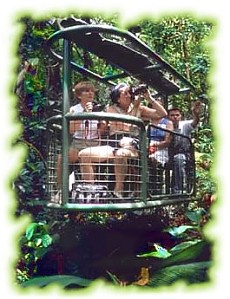
Too quickly, our ride drew to a close without us having seen more than a few birds but a lot of plant life. However, our activities weren't over yet. Our guide asked us to wait since he had to wait for the next batch of people as well, and then we would go on a nature walk of the forest floor, thus allowing us to view the rainforest at three different levels. While we waited, we got a closer look at the pit viper (one of these days I'll get my own photos up), which looked like a big clump of mud sitting on a leaf unless you were paying attention and realized it really was a coiled up brown snake. The pit viper is quite venomous and medical treatment should be sought immediately if bitten. When I mentioned how I had almost mistaken the pit viper for mud, Orville explained this was one of the reasons why we needed to stay on the path while walking through the forest, and to watch where our hands went. He said that the most common bites occurred because the snakes rest at right around hand level, and people walking along swinging their arms will brush against one without realizing it, and get bitten. The guides knew what to look for, but he wanted the visitors to be careful. Sergio had also mentioned on the bus how coffee pickers had a very dangerous job, and Orville elaborated. He said that usually the coffee pickers were paid very little by the basket, so they were interested in picking as much as possible as fast as possible, so they'd just reach in to the plants with both hands to strip off branches of the coffee beans, and would often get bitten by hidden pit vipers that had chosen those plants as a place to rest. As we moved on to wait outside the visitor center, we noticed other guides peering at a tree trunk right by one of the buildings, and Orville motioned us over to come look. We were rather disgusted and fascinated to discover the inch-long bullet ants crawling along the trunk of a tree. Orville explained how the bullet ant had a strong, painful sting - like a bullet - and how it was another hazard to watch out for while walking through a rainforest. We had another opportunity to peer at the sloth, but then had to gather for our rainforest floor walk.

Shortly after we embarked along the path, Orville stopped us to indicate a long trail of leafcutter ants and their cuttings that went along the edge of the path for quite a while before crossing over to the other side (with a rather amusing leafcutter crossing sign depicting an ant carrying a leaf on the path), continuing along the path, and the diverting off into the forest until reaching the nest - a huge heap of mud littered with leaf cuttings. He told us a bit more about the leafcutters, how there were the workers that cut the leaves and carried them back to the nest, and then there were soldier ants which didn't forage or carry, but defended the worker ants, sometimes sitting on the worker ants as they worked to ward off attacks. I think he told us, though I didn't quite take in until another guide later in the trip told us again, that the leafcutters don't eat the leaves, they take them back to turn into fungus. Reading wikipedia, more specifically they apparently harvest a special fungus in their nests, and the leaves are how they feed the fungus. Their whole community structure and foraging habits are quite fascinating. As we continued along the path, he would stop to point out various other plants that he had shown us from the tram, talking more about them, showing us the roots of the epiphytes, talking about various ferns and their growth patterns and uses, etc. At one point, we spotted a lizard by the path, so of course I had to stop and take a photo. The walk was faster than I expected, and we were soon back at the visitor center.
My mom and sister wanted to visit the gift shop but I was quickly distracted by the sight of a Swarovski telescope pointed upwards, and went to look through it. To my surprise, I found a crystal clear image of a sloth in the trees above me. After searching for a while (my wildlife spotting skills proved to be extremely poor during this trip), and help from my bf and sister who had both spotted it first, I finally located the sloth in the tree, much closer than it had been earlier, and more active than I expected. Sloths are supposed to be quite still and slow-moving, sleeping most of the day away, but this one, while we were watching, went from sitting on a branch to hanging upside down and vigorously scratching its head with both paws, affording us a very clear view of its 3 long claws on each paw, and eventually of its rather adorable face. For whatever reason, 3-toed sloths' facial features make it look like it's smiling happily, which just makes them all the cuter. IIRC, we were told that the 3-toed sloth's range in their lifetime is generally no more than 50 ft (or 50 m? not quite the same thing), unless that was the howler monkey they were talking about, and they rarely come down from the trees (though apparently they do come down for "peeing and pooping", they just don't do it that often). However, female sloths will leave their territory to their children, and move to a new area. The sloth we saw would probably have to leave the area in the future because, to our delight, we discovered that a baby sloth was clinging to it and mimicking its movements. It could just be that whatever insects or pests were bothering the mother were also bothering it, but it looked like it was copying its mother, also scratching at its head with its little paws. Eventually, this quite active sloth decided to check out a new area, and began moving surprisingly rapidly along the branches while its baby clung to it, until it went behind a clump of leaves and we couldn't watch it anymore (and our guide called us to board the bus back to the parking area).
It was another short bus ride out of the park until we stopped at a restaurant for lunch. I forgot what it was called, but it had a butterfly garden in back, and was where we also stopped for lunch on our way out of Tortuguero. The restaurant was covered but open-air, with a small buffet where we told the servers which foods we wanted and got a plate full of food in return. I think it was this time when they served us soursop juice, which was way sweeter and yummier than the name makes it sound. We ate quickly and then went to explore the butterfly garden. It was a sunny bright day by this point, and, unlike the previous butterfly garden, the butterflies were extremely active and profuse. Taking photos was almost impossible as the gorgeous blue morphos and butterflies of a huge variety of sizes and colors flitted back and forth around the garden. The problem with the morphos was that when they're at rest, they fold those gorgeous blue wings closed, leaving us to look at the brown camouflaging underside. They occasionally flap those wings open, giving us tantalizing glimpses at the blue, but otherwise were either brown at rest or moving too quickly to catch. The other butterflies were also beautiful - black with orange, red, or yellow markings. It was starting to get hot for the first time the trip at this point, and it was nice to go back to the air-conditioned comfort of the bus and zip off the legs of our convertible pants (best pre-trip purchase I made, not even so much for the convertible nature, though that was useful, but because the pants dried quickly and had a lot of useful pockets).
More time in the bus, while Sergio told us more about the agriculture of Costa Rica and the crops they grew. We passed through miles of banana plantations, and Sergio told us about how they grew bananas - how each bunch was bagged on the tree to protect them and provide a little mini-environment for optimal growth, how they determine when it's time to bag the bunches, how the bananas initially grow downwards but then eventually curl upwards against gravity (I think), how the bananas were bred to be seedless and how they planted new ones... We were surprised to see a line of bagged bunches of bananas tied to a cable and being pulled along by a running man, and discovered this was how they transported the harvested bananas to the banana plant. There was a system of cables and pulleys running throughout the plantation with paths underneath, and even banana crossings on the road where they would put down a barrier while the line of bananas were run across the street, and gulleys where the man would send the bananas gliding across while he took the long way around and picked them up again on the other end. Eventually, we passed the processing plant that was the destination for these bananas (I believe it belonged to Chiquita). It was all quite fascinating.
Oh I almost forgot - on the bus ride, we saw two sloths - the 3-toed sloth was on the right side of the bus, where I was sitting, so I got to see it. The 2-toed was on the other side of the bus, and I never did spot it. In fact, apparently a couple 2-toed sloths were seen on this trip and somehow I never saw them.
The only way to reach our next destination, Tortuguero, was by boat or air, on small planes, since the area is completely surrounded by water. By boat, there are apparently two main departure points which Caravan uses (and maybe in general) - Cano Blanco, which was further by boat to our hotel, and another port whose name I forget (Moin, maybe?), but was the way we took to get to Tortuguero. The boats departed from a fairly run down building with nothing but farmland around - two covered but open-air low boats that took our luggage and us to our hotel. Oh and a note on our luggage - because we had to take these small boats to Tortuguero, we were only allowed to bring one carry-on bag each with what we needed for our two night stay, so we had packed a duffel bag of stuff and then brought my camera backpack. Our suitcases would stay on the bus while we were in Tortuguero. I should mention that I love boat rides - not necessarily big boats on large open bodies of water, but smaller motor boats, canoes, etc, on rivers and canals? That gliding, speeding sensation with the wind in your face, the spray of the water? Just makes me happy. So our boat ride to our hotel - Laguna Lodge - was very happy-making for me. The objective of this boat ride was mostly to get to the hotel, not to look at wildlife, but they did stop when the guide with our boat spotted a group of howler monkeys in the trees so we could all get a good look at the first of many, many animals we'd be seeing over the next couple days. Some of the monkeys were just sort of hanging out, or traversing the branches, but one seemed to peer down at us as we peered up at it. The guide then directed our attention to the trunk of the tree, where a number of small tree bats clung to the trunk - small dots on the trunk we never would have noticed if he hadn't told us they were there. With that introduction to the wildife of Tortuguero, the boat then continued to speed us along to our destination, with the guide pointing out Tortuguero village along the way.
Our hotel for our stay in Tortuguero immediately got things off on a good foot (and was our introduction to our culinary highlight of our stay there) by greeting us with glasses of coconut milk (or coconut cream? coconut goodness, anyway) and some sort of warm baked good of cheese and beans and something that everyone but my bf enjoyed. The manager went over a bunch of information about the hotel, including the request that we please not flush any toilet paper down the toilet, and information about the meal times. Eventually, after people in our group somehow managed to break like 3 glasses, we were dispatched off to find our rooms. The Laguna Lodge was billed as "rustic" but it was really quite nice. The rooms were located in these low slung wooden lodge buildings with a long porch running along the front, lined with rocking chairs. The rooms were clean and simple, with a double bed and twin bed in each, and a fairly large private bathroom with a decent shower and nice mosaic mirror. There was only soap - no shampoo or other amenities, and there was no air-conditioning - just a fairly powerful rotating fan on the ceiling, and it was obvious how hot it was in the area from the fact that the beds were made up with sheets and one thin blanket. The windows had no glass - just screens and shutters - and there was basically no sound isolation from your neighbors as a consequence. However, having been made to expect very little, we found the lodge quite pleasant.
After settling into our rooms, my bf and I set out to do some exploring. We quickly discovered that there was a colony of leafcutter ants in the area, from the long line of leafcutter ants going across the path into the lawn between the lodges... and suddenly we realized that the grass was constantly moving - ants were everywhere, cutting and shifting the leaves around, so it seemed like the lawn was alive. My bf and dad followed the path all the way to the beach, where they discovered the ants disappearing into a hole under a tree. Ah yes, the beach - did I mention that the lodge was located on a thin strip of land with the lagoon/river on one side, where we came in, and the Caribbean on the other? There was a beach were evidently the green turtles the area is famous for come to nest (we missed the season), and a lovely view of the Caribbean (though we were advised not to swim due to strong undertow and currents). We all spent a lovely while on the beach, playing in the black sand (my sister apparently thought she could build a sand structure to outlast the waves). Quite randomly, I found a banana that appeared to have just washed up on the beach. Wonder where that fell into the water. My bf and I wanted to catch the sunset (which was on the other side, obviously, since the Caribbean is the east coast of Costa Rica) but were too late. Instead, we spent some time exploring the restaurant/bar/gift shop/front desk area on the lagoon side after glancing at the pool on our way by from the beach.
Eventually, it was time for our briefing (which I think came before dinner). The itinerary said we were going to get a talk by a naturalist but we ended up just watching a video about the area. The meeting room was kind of funky, with big mosaics on the floor, and a Gaudi-like design to the place. The video was ok. Sergio gave us some more information on our schedule for our stay in Tortuguero, and then it was time for dinner. My bf rather amusingly insisted we sit in the back of the room so we could be the first to dinner, and we therefore managed to claim the table right by the water. Another buffet-style dinner here, but one big difference between this buffet and the one at the Barcelo was that the entire eating area was open to the outdoors, so we had a lot of flies helping themselves to our fruit and veggies. Kind of turned me off eating a lot of fruit and salad while we were at Laguna Lodge. They also had a grill with hot foods and steamed vegetables, though, so there was more than enough to eat. Our favorite thing about Laguna Lodge, however, turned out to be the fresh fruit juices the waiters served us with - a different juice every meal, and for the most part quite yummy. Since I won't remember which meal went with which drink, here's a list of the juices I can remember us having there - coconut, tamarind, blackberry, papaya, limonida, pineapple, and watermelon/fruit punch (no, we didn't have that many meals but they provided between meals refreshments at least once, and the coconut was our welcome drink). As we sat at our table by the water, we strained our eyes to see the water in the dark, but couldn't see much. However, we kept hearing splashes, and occasionally seeing large disturbances in the water. We were trying to figure out if it was fish jumping, or what. We finally figured out that at least some of the splashes came from hunting birds, but others seem to come from the water itself. It was kind of fascinating.
Laguna Lodge is rather dark - there isn't much public lighting - so they advised us bring flashlights to walk around. I think it was this night where we played Pay Me in my parents' room for a while before bed, but we still got to bed relatively early to be ready for the next morning.
Thursday, January 10, 2008
Better dot those T's
This rather disproportionately amuses me - as I was deleting ER from the DVR after watching it, I caught part of KNTV News reporting on apparently another collision with the Bay Bridge by a boat. I swear I heard the anchor say that the Coast Guard was determined to make a better response after being so criticized for their response in November, and that's why they were making sure to "dot their T's". It's always important to cross your i's and dot your t's!
On a much less amusing note, apparently figure skater Christopher Bowman has died. He was only 40 years old, found dead in his motel room, suspected of a possible drug overdose. Bowman was a bit before my time, but one of the prime competitors for a while of my favorite skater, Kurt Browning. Kurt was quoted as saying that Chris Bowman was the skater he was most scared of coming up in the ranks, because he had such a huge talent, and that if he had gotten his act together, he would have easily beaten Kurt. What I've always heard is that Bowman was a huge talent but hugely troubled. It's just so sad that he doesn't seem to have been able to overcome his demons. May he rest in peace.
On a much less amusing note, apparently figure skater Christopher Bowman has died. He was only 40 years old, found dead in his motel room, suspected of a possible drug overdose. Bowman was a bit before my time, but one of the prime competitors for a while of my favorite skater, Kurt Browning. Kurt was quoted as saying that Chris Bowman was the skater he was most scared of coming up in the ranks, because he had such a huge talent, and that if he had gotten his act together, he would have easily beaten Kurt. What I've always heard is that Bowman was a huge talent but hugely troubled. It's just so sad that he doesn't seem to have been able to overcome his demons. May he rest in peace.
Costa Rica - Day Two
We got up really early (7:30AM departure, 6:30AM breakfast) for our first real day on tour (they say 10-day tour, but it's really 8-day tour plus 2 days for traveling to/from the country). The extra earliness was to try to get to the Poas Volcano (1.5 hour drive away) before the rest of the crowds, in particular before the other Caravan group, and also in hopes of beating the clouds that gather over the volcano later in the day. We started off the day with my first introduction to the traditional Costa Rican breakfast - gallo pinto (rice and beans) with eggs, as well as traditional American foods like french toast, croissants, etc, and a good collection of fruit. The Barcelo's breakfast buffet was a lot more satisfying than their dinner buffet, IMO. As we drove through the countryside on our comfortable Mercedes Benz motor coach (leather seats, A/C, and nice driver, Marcos), Sergio told us a little about Costa Rican culture and history, about the abolition of the army, the conservation efforts, the mandatory education for all school-age children, and the 96% literacy rate of the country. He pointed our attention to a flock of goats scrambling out of the way of the bus, and told us how we were in the Central Valley, where the majority of the population lives. He also told us about the seven provinces of Costa Rica, and which we were going to visit on the tour (I think he said 5 of the 7 - looking at Wikipedia I think we visited San Jose, Limon, Puntarenas, Alajuela, and very likely Heredia). He also told us a bit about Poas Volcano, which we were about to visit. It's an active volcano, but remains more or less dormant with low-key activity - it has a very low pH, boiling hot lake in the crater, and there are occasionally poofs of smoke or geysers, but the last major "blowout" was in 1953.
When we arrived at Poas, it appeared we weren't going to get lucky - it had been raining intermittently and the weather was cloudy and overcast, and initially Sergio was going to have us watch a video in the visitor's center before heading to the crater overlook. However, the skies started to clear a bit and the sun started to come out, so he decided to take our chances and head out to the volcano right after the inevitable restroom break (given that the majority of the tour was female, you can guess how quickly those went). On the 1km, straight level walk to the overlook, he stopped from time to otime to show us various plants - the "poor man's umbrella" with huge leaves big enough to serve to keep the rain off you, "rubber plants" with rubbery-textured leaves, and various other flowers and plants. When we got to the overlook, it seemed our luck had turned against us - nothing could be seen but dense fog, the sky was completely overcast, and things were pretty wet. As a joke, we photographed the "Do not descend into the crater" sign with the blanket of dense fog behind it - what crater? - and then spent a lot of time staring into the fog, trying to see something. Sergio dissuaded us from taking the 20 minute hike to another, dormant, smaller crater lake since he said there wasn't that much time (that was one of the disadvantages of the Caravan tour - limited time at each stop) and that if you couldn't see anything here, it'd be completely foggy there as well. My dad was close to giving up several times, wanting to walk back to the visitor's center, not seeing the point of standing out in the cold wind and rain to look at fog, but we were determined not to leave until Sergio left.
Turns out our patience paid off. All that wind that was freezing our ears off finally shifted in just the right way to suddenly blow away the clouds. We watched in disbelieving anticipation, initially thinking that the vague views of the crater outline were as good as it was going to get, snapping photo after photo as the clouds swirled around. It seemed like all of a sudden we were standing under bright blue skies, sunshine, with a perfectly clear view of the entire creater area, like it had never been cloudy at all. We could see the crater lake, the fumeroles behind it, the ragged rock cliffs around the crater, off into the valley beyond the crater...it was gorgeous and quite cool. I must admit I took way too many photos of essentially the same thing (theme of the entire trip). Another tour group arrived almost in perfect time to see the clear conditions and view the crater, but then within another few minutes, the wind had blown all the clouds back into place, and Poas Volcano was once again hidden from view.
We were given a bit of time to look through the exhibits at the visitor center and marvel at photos of previous eruptions, try to puzzle through big posters of scientific papers written on the volcano, and learn a bit more through trying to decipher the Spanish under the photos. Then it was time to get back on the bus and head back to San Jose to get lunch at our hotel. Buffet-style, of course. The theme for that night was Italian, and the lunch picked up the theme as well, with a made-to-order pasta chef. IIRC I passed on the pasta, thinking I could get it that night, even though the bolognese sauce was extra-yummy. On the bus ride back, Sergio told us a bit about the agricultural aspects of the country, and indicated to us vast stretches of hill/countryside covered in black material - essentially greenhouses for the decorative plants that Costa Rica exported to places like the US. He said that Costa Rica was the #1 exporter of decorative plants in Central America.
After a bit of a break after lunch, we loaded back into the buses to drive into San Jose (our hotel was located in the "business district" and not downtown). Our San Jose visit didn't really involve seeing much of San Jose at all, and really didn't involve walking around it. The bus drove us through the streets past the Plaza de la Cultura, the Central Park, and the National Theater, but didn't stop anywhere, much less let us out. The rather confused fast impression I got of San Jose was that it wasn't like any other big city/capital I'd seen in that it didn't feel like there were tall buildings, the streets were fairly narrow, things didn't feel all that open, I didn't get the sense of much centralization, and that all the houses and buildings were fortified up the wazoo. Reading the Lonely Planet guide, it seems like I got the wrong impression since it claims it's "Packed with office towers, shopping malls and fast food restaurants." We did see some shopping districts with a lot of American chain stores and other very modern looking shops but otherwise there wasn't much. I wasn't given a strong impression of San Jose before arriving, though - my friend whose family is from Costa Rica advised me to stay out of the big cities since they weren't very interesting and riddled with crime (lots of theft, apparently, which accounts at least somewhat for the barricaded houses). We did get lucky in one sense in that apparently San Jose is usually extremely packed with a lot of traffic, but we went during the Costa Ricans holiday period, and much of San Jose was away travelling on *their* vacations, but that's probably one of the reasons I didn't get the impression of a bustling city.
We eventually did stop at the National Museum, which was located in the Bellavista Fortress, and still bears the bullet holes on its facade from the 1948 civil war. Evidently the president who abolished the armed forces - Jose Figueres Ferrer - was the one responsible for turning the fortress into a museum, and wanted the holes left there as a reminder of the costs of war. He also took a sledgehammer and symbolically knocked down one of the exterior walls, saying he didn't want there exist this separation that blocked the view of San Jose, or something to that effect. The museum housed a number of artifacts and a bunch of information on Costa Rican history, from the first natives who lived there to information on the present-day political and economic situation of Costa Rica. It was fairly interesting, though very dimly lit. Sergio also told us about the famous "stone spheres" that have been discovered all around Costa Rica, but whose purpose is completely unknown. They range from fairly small to up to 2 meters in diameter, and the museum had several examples. The museum also had a butterfly garden, but since the weather was on the drizzly and cool side, most of the butterflies were pretty dormant. At first we didn't think we were going to see any, but then we started noticing various butterflies at rest. It was kind of like looking at one of those "Magic Eye" pictures (not that I've ever been able to see those) - as soon as your eyes make the shift, suddenly you can see butterflies all over. OK, there weren't *that* many, but we did see several hanging off one tree in particular, or lines of butterflies along single plant stems, which was fairly neat.
After the museum, we all loaded back on the bus and headed back to the hotel. Most days on the tour ended by like 3:30 or so, so there was a lot of downtime in the evenings. Dinner was usually served at 7. On the other hand, since most mornings started as early as this one, we tended to want to get to bed between 9 and 10 anyway, so we ended up with less downtime than you'd expect. At any rate, my family, bf and I ended up first chatting by the pool, and then when it got dark, moved indoors to the lobby area to play cards. There we introduced my bf to "Pay Me", a game my dad taught us all where you essentially try to make runs of a minimum of 3 cards of either 3 of a kind or a straight flush. You start with 3 cards in your hand the first round, with 3 being the wild card, and go in turn, picking up a card from either the pile or the discard, and discarding one of your own, until someone finally gets either 3 of a kind or a straight flush and says "Pay Me." At that point, whatever is left in your hand counts against you based on the numerical face value (royals are worth 10 points), so everyone has one more chance to draw one more card and either try to complete a pay me or get rid of the highest valued card in their hand. You can build off of the "Pay Me" person's cards - if they have a straight flush and you have the card right before or after, that won't count against you, or if you got a "Pay Me" - a run of 3 cards fitting the rules - yourself, then that also didn't count against you. The next round, it went up to 4 cards in your hand, with 4 as wild, so you had to get 4 of a kind or a 4-card straight flush. The next round was 5 cards, 5 wild, needing 5 of a kind or 5-card straight flush (we tended to play with more than one deck). Then with the 6 card round, you could go back to making 2 sets of 3 cards, or a set of 6, etc etc... This kept us occupied all the way until dinner.
At dinner, I was disappointed to find they only had marinara sauce and not bolognese, so I ended up just getting a bunch of buffet items and desserts, and forgoing the pasta. As it turned out, that wasn't my last opportunity to have pasta in Costa Rica either. Evidently, Italian and Chinese food are the most popular foreign foods in Costa Rica.
Early bedtime since we were expected to have our bags outside our doors for the bellboys to pick up at 6am, and leave the Palacio by 7am.
When we arrived at Poas, it appeared we weren't going to get lucky - it had been raining intermittently and the weather was cloudy and overcast, and initially Sergio was going to have us watch a video in the visitor's center before heading to the crater overlook. However, the skies started to clear a bit and the sun started to come out, so he decided to take our chances and head out to the volcano right after the inevitable restroom break (given that the majority of the tour was female, you can guess how quickly those went). On the 1km, straight level walk to the overlook, he stopped from time to otime to show us various plants - the "poor man's umbrella" with huge leaves big enough to serve to keep the rain off you, "rubber plants" with rubbery-textured leaves, and various other flowers and plants. When we got to the overlook, it seemed our luck had turned against us - nothing could be seen but dense fog, the sky was completely overcast, and things were pretty wet. As a joke, we photographed the "Do not descend into the crater" sign with the blanket of dense fog behind it - what crater? - and then spent a lot of time staring into the fog, trying to see something. Sergio dissuaded us from taking the 20 minute hike to another, dormant, smaller crater lake since he said there wasn't that much time (that was one of the disadvantages of the Caravan tour - limited time at each stop) and that if you couldn't see anything here, it'd be completely foggy there as well. My dad was close to giving up several times, wanting to walk back to the visitor's center, not seeing the point of standing out in the cold wind and rain to look at fog, but we were determined not to leave until Sergio left.
Turns out our patience paid off. All that wind that was freezing our ears off finally shifted in just the right way to suddenly blow away the clouds. We watched in disbelieving anticipation, initially thinking that the vague views of the crater outline were as good as it was going to get, snapping photo after photo as the clouds swirled around. It seemed like all of a sudden we were standing under bright blue skies, sunshine, with a perfectly clear view of the entire creater area, like it had never been cloudy at all. We could see the crater lake, the fumeroles behind it, the ragged rock cliffs around the crater, off into the valley beyond the crater...it was gorgeous and quite cool. I must admit I took way too many photos of essentially the same thing (theme of the entire trip). Another tour group arrived almost in perfect time to see the clear conditions and view the crater, but then within another few minutes, the wind had blown all the clouds back into place, and Poas Volcano was once again hidden from view.
We were given a bit of time to look through the exhibits at the visitor center and marvel at photos of previous eruptions, try to puzzle through big posters of scientific papers written on the volcano, and learn a bit more through trying to decipher the Spanish under the photos. Then it was time to get back on the bus and head back to San Jose to get lunch at our hotel. Buffet-style, of course. The theme for that night was Italian, and the lunch picked up the theme as well, with a made-to-order pasta chef. IIRC I passed on the pasta, thinking I could get it that night, even though the bolognese sauce was extra-yummy. On the bus ride back, Sergio told us a bit about the agricultural aspects of the country, and indicated to us vast stretches of hill/countryside covered in black material - essentially greenhouses for the decorative plants that Costa Rica exported to places like the US. He said that Costa Rica was the #1 exporter of decorative plants in Central America.
After a bit of a break after lunch, we loaded back into the buses to drive into San Jose (our hotel was located in the "business district" and not downtown). Our San Jose visit didn't really involve seeing much of San Jose at all, and really didn't involve walking around it. The bus drove us through the streets past the Plaza de la Cultura, the Central Park, and the National Theater, but didn't stop anywhere, much less let us out. The rather confused fast impression I got of San Jose was that it wasn't like any other big city/capital I'd seen in that it didn't feel like there were tall buildings, the streets were fairly narrow, things didn't feel all that open, I didn't get the sense of much centralization, and that all the houses and buildings were fortified up the wazoo. Reading the Lonely Planet guide, it seems like I got the wrong impression since it claims it's "Packed with office towers, shopping malls and fast food restaurants." We did see some shopping districts with a lot of American chain stores and other very modern looking shops but otherwise there wasn't much. I wasn't given a strong impression of San Jose before arriving, though - my friend whose family is from Costa Rica advised me to stay out of the big cities since they weren't very interesting and riddled with crime (lots of theft, apparently, which accounts at least somewhat for the barricaded houses). We did get lucky in one sense in that apparently San Jose is usually extremely packed with a lot of traffic, but we went during the Costa Ricans holiday period, and much of San Jose was away travelling on *their* vacations, but that's probably one of the reasons I didn't get the impression of a bustling city.
We eventually did stop at the National Museum, which was located in the Bellavista Fortress, and still bears the bullet holes on its facade from the 1948 civil war. Evidently the president who abolished the armed forces - Jose Figueres Ferrer - was the one responsible for turning the fortress into a museum, and wanted the holes left there as a reminder of the costs of war. He also took a sledgehammer and symbolically knocked down one of the exterior walls, saying he didn't want there exist this separation that blocked the view of San Jose, or something to that effect. The museum housed a number of artifacts and a bunch of information on Costa Rican history, from the first natives who lived there to information on the present-day political and economic situation of Costa Rica. It was fairly interesting, though very dimly lit. Sergio also told us about the famous "stone spheres" that have been discovered all around Costa Rica, but whose purpose is completely unknown. They range from fairly small to up to 2 meters in diameter, and the museum had several examples. The museum also had a butterfly garden, but since the weather was on the drizzly and cool side, most of the butterflies were pretty dormant. At first we didn't think we were going to see any, but then we started noticing various butterflies at rest. It was kind of like looking at one of those "Magic Eye" pictures (not that I've ever been able to see those) - as soon as your eyes make the shift, suddenly you can see butterflies all over. OK, there weren't *that* many, but we did see several hanging off one tree in particular, or lines of butterflies along single plant stems, which was fairly neat.
After the museum, we all loaded back on the bus and headed back to the hotel. Most days on the tour ended by like 3:30 or so, so there was a lot of downtime in the evenings. Dinner was usually served at 7. On the other hand, since most mornings started as early as this one, we tended to want to get to bed between 9 and 10 anyway, so we ended up with less downtime than you'd expect. At any rate, my family, bf and I ended up first chatting by the pool, and then when it got dark, moved indoors to the lobby area to play cards. There we introduced my bf to "Pay Me", a game my dad taught us all where you essentially try to make runs of a minimum of 3 cards of either 3 of a kind or a straight flush. You start with 3 cards in your hand the first round, with 3 being the wild card, and go in turn, picking up a card from either the pile or the discard, and discarding one of your own, until someone finally gets either 3 of a kind or a straight flush and says "Pay Me." At that point, whatever is left in your hand counts against you based on the numerical face value (royals are worth 10 points), so everyone has one more chance to draw one more card and either try to complete a pay me or get rid of the highest valued card in their hand. You can build off of the "Pay Me" person's cards - if they have a straight flush and you have the card right before or after, that won't count against you, or if you got a "Pay Me" - a run of 3 cards fitting the rules - yourself, then that also didn't count against you. The next round, it went up to 4 cards in your hand, with 4 as wild, so you had to get 4 of a kind or a 4-card straight flush. The next round was 5 cards, 5 wild, needing 5 of a kind or 5-card straight flush (we tended to play with more than one deck). Then with the 6 card round, you could go back to making 2 sets of 3 cards, or a set of 6, etc etc... This kept us occupied all the way until dinner.
At dinner, I was disappointed to find they only had marinara sauce and not bolognese, so I ended up just getting a bunch of buffet items and desserts, and forgoing the pasta. As it turned out, that wasn't my last opportunity to have pasta in Costa Rica either. Evidently, Italian and Chinese food are the most popular foreign foods in Costa Rica.
Early bedtime since we were expected to have our bags outside our doors for the bellboys to pick up at 6am, and leave the Palacio by 7am.
Small food post
Went to Patxi's Chicago Pizza (511 Hayes between Laguna and Octavia) with my sister before leaving for break. It was all right - the pizza toppings themselves were quite yummy - we just got the Hawaiian, I think, and it was all cheesy with tangy tomato sauce and good. The crust (deep dish, of course) was eh. Nothing to write home about. The bottom layer was quite thin which made the pizza soak through pretty rapidly, whereas the outer layer was fine but not particularly tasty. I'd go again just b/ it's there, but it's definitely not the best deep dish I've had (and for point of reference I think I still like Pizzeria Uno's the best of what I've tried...).
Last night, went to Minh Tri Vietnamese Cuisine (534 Irving St, between 6th and 7th) because I had a vague urge for Vietnamese food. I'm wondering if it's a matter of not really knowing what to order, b/c my bf liked it fine. They seem to only have pho on their lunch menu, incidentally. He got the "Mint Pork", which was pork fried with basil (mint?), and a vietnamese ice tea (which = tea dripping onto condensed milk while he fidgets impatiently, kind of like vietnamese ice coffee = coffee dripping onto condensed milk while he fidgets impatiently) and seemed to like both just fine. I hate basil so I didn't try his dish. I got the "Homemade Chicken" which was chicken breast pieces stir fried with bok choy (not the leaves, just the stems), mushrooms, green onions, and eggs in a n "eggy Vietnamese sauce" which I interpreted as meaning there would be..sauce. But it ended up being a kind of dry dish since chicken breast is already dry, and none of the other ingredients add much moisture either, and the sauce mainly seemed to be black pepper seasoning. Kind of disappointing. My hot soy milk was good - standard hot soy milk. I wonder if their other dishes are better, given how many positive reviews they get on yelp. One note, though - about 95% of the clientele while we were there were white. The service was friendly and the food came out pretty fast, but then we didn't get our bill for the longest time b/c apparently the guy thought we were "talking" and didn't want to interrupt. In the meantime, we were watching nextmuni tick down the time to our next bus on the bf's iPhone, and getting more and more annoyed. Sigh. We made our bus, but that's only b/c it was 28 minutes away from when we first checked =P.
Random note - while I get impatient at the 1/2 hour bus ride to work (and from work), I do have to say there's a definite advantage in that usually there aren't too many people on the bus when we get on at either end, since most of the people get off somewhere in the middle. That means I usually get a seat...
Last night, went to Minh Tri Vietnamese Cuisine (534 Irving St, between 6th and 7th) because I had a vague urge for Vietnamese food. I'm wondering if it's a matter of not really knowing what to order, b/c my bf liked it fine. They seem to only have pho on their lunch menu, incidentally. He got the "Mint Pork", which was pork fried with basil (mint?), and a vietnamese ice tea (which = tea dripping onto condensed milk while he fidgets impatiently, kind of like vietnamese ice coffee = coffee dripping onto condensed milk while he fidgets impatiently) and seemed to like both just fine. I hate basil so I didn't try his dish. I got the "Homemade Chicken" which was chicken breast pieces stir fried with bok choy (not the leaves, just the stems), mushrooms, green onions, and eggs in a n "eggy Vietnamese sauce" which I interpreted as meaning there would be..sauce. But it ended up being a kind of dry dish since chicken breast is already dry, and none of the other ingredients add much moisture either, and the sauce mainly seemed to be black pepper seasoning. Kind of disappointing. My hot soy milk was good - standard hot soy milk. I wonder if their other dishes are better, given how many positive reviews they get on yelp. One note, though - about 95% of the clientele while we were there were white. The service was friendly and the food came out pretty fast, but then we didn't get our bill for the longest time b/c apparently the guy thought we were "talking" and didn't want to interrupt. In the meantime, we were watching nextmuni tick down the time to our next bus on the bf's iPhone, and getting more and more annoyed. Sigh. We made our bus, but that's only b/c it was 28 minutes away from when we first checked =P.
Random note - while I get impatient at the 1/2 hour bus ride to work (and from work), I do have to say there's a definite advantage in that usually there aren't too many people on the bus when we get on at either end, since most of the people get off somewhere in the middle. That means I usually get a seat...
Wednesday, January 9, 2008
Costa Rica - Day Zero/Day One
My parents and I booked flights to get into San Jose, Costa Rica, a day before the tour was due to start. This was a semi-hellish travel day, in that we had to fly through Chicago and Miami to get to San Jose, and we had a 6.5 hour layover in Miami. The Miami airport was a little odd to me in that it seemed to be a hub with spokes (the terminals) going outwards, and the ends of the spokes connected via rail. There was very little in the way of interesting food inside the terminal, and it wasn't much better outside security, either, but at least somewhat better. My mom and I ended up eating at the "Club Bacardi", where all the food had some Bacardi component to it (we had salads and the dressings were Bacardi), while my sister got CPK and my dad got Burger King. For dinner, we had Pizza Hut. Such healthy eating. We decided not to venture outside the airport into Miami, so much of our time was spent sitting in the food court, reviewing our itineraries and reading the Costa Rica guidebook I had on me. (Fact: Costa Rica never declared their own independence, they just kind of went along when Guatemala (I think) declared independence from Spain for all the Central American countries)
When we finally arrived in San Jose, it was pretty late. After going through customs and retrieving our bags, we found ourselves in a rather confusing swirl of activity. Because we already had Caravan tags on our bags, there was some confusion as various Caravan personnel inside and outside the airport assumed we were with them and tried to direct us to their shuttles. Caravan only provides transport to/from the airport on your tour's actual arrival/departure dates, though, and we had booked a night at a different hotel than the tour hotel anyway. I spotted the Best Western Irazu shuttle going by, though, so I quickly wove my way past the various tour personnel and people offering taxis, and made my way to the shuttle, only to discover that since they were the last shuttle of the day, they were going to wait around for a while to make sure they got everyone so the running was unnecessary.
When we arrived at the hotel, we were greeted by the sounds of "My Heart Will Go On," courtesy the open-air karaoke bar located right at the entrance of the hotel. The singer wasn't terrible, but it was rather amusing. The Best Western itself was an ok hotel. The shared areas - the pool, the lobby, etc - were all fairly nice, and they had a business center with free internet. The room itself was mediocre - a little run-down, hardish beds (fairly typical for Costa Rica), a sink that spurt water everywhere, and a shower that took a while to warm up. Exhausted from all the travel, we quickly went to bed, though I was kept up by the sounds of the A/C, my dad snoring, everyone breathing... I'm not a good sleeper and the first night in a strange place rarely is a good night of sleep for me.
The next morning, we were called by my bf, who had flown on the red-eye from SF and just arrived in San Jose in the early morning. I had figured out from the limited maps provided on the Best Western and Barcelo Palacio websites that the hotels were on the same road and probably relatively close, but I had no idea how close. It turned out that the hotels were just down the street from each other, literally one exit away on the highway but a rather dangerous walk on streets with no sidewalks and deep gutters, crossing highway entrance/exit ramps. My bf walked over from the Barcelo Palacio but then we took cabs after that. My mom really wanted to explore the Best Western, and try out a restaurant across the street that had gotten good reviews, but my bf wanted to shower (the rooms weren't ready when he'd arrived that morning) so he and I ended up taking a couple trips back and forth. The hotel had included free breakfast in the attached Denny's with the room - fairly limited small menus - so my bf ate there as well. That Denny's was quite overpriced, with most of the items $8 US or higher. There actually were Denny's attached to several of the hotels I saw. Welcome to Costa Rica - it's just like the US!
The Best Western itself was, like I said, fairly nice but not incredibly fascinating. We sat by the pool some (the pool itself was quite cold), we went on the Internet so I could try to get info on some ziplining tours, and we visited the gift shop where we discovered that Costa Rican gift shops had two things I quite like - chocolate covered fruits (there were samples) and pretty wood products. At the time, I resisted buying anything, quite convinced that we'd find better and cheaper stuff elsewhere, but my mom started her souvenir buying right then and there. Eventually, lunch time rolled around (though I think this was actually before the gift shop visit) and we trotted across the street to "La Gallera," a cute restaurant with a strong rooster theme. Roosters on the placemats and coasters, roosters of various designs in the artwork and on a series of plates on one wall. The menu looked really interesting so we happily went to town, ordering two different ceviches (one a Peruvian, I think, style one which was more traditional - sea bass with a strong lemon flavoring, and one a Coconut one - I forget all the components in it, but my bf loved that one), a couple juices (my pineapple was good, my bf liked his strawberry much better than his blackberry), a soup (I didn't try it), and split 3 entrees among the 5 of us. My bf and I got a plantain-stuffed pork (didn't see the stuffing but it was still pretty yummy), my sister and mom split a beef tenderloin with a coffee/pineapple sauce (fairly interesting), and my dad got a Cuban sandwich with great fries. It was a bit of an indulgence but given that all meals were included on the tour, our only opportunity to try a restaurant on our own. It was quite good!
Eventually we made our way to our tour hotel, the Barcelo Palacio just down the street. My mom was forced to concede that the Barcelo was a lot nicer and more interesting than the Best Western. We met the tour director, Sergio, who showed us the restaurant where we'd be having dinner, told us about our 8pm briefing, hooked us up with our rooms, and told us where everything was in the hotel. The Barcelo is quite a nice hotel - the rooms are beautiful, with dark wood built-in cabinets, nice bathrooms, and nice bedding with a choice of pillows of various softness. The beds themselves were sometimes really comfy and sometimes not, because they were hard mattresses with a layer of down comforter or something laid on top (under the sheet) so they seemed soft but you had to find the right spot on the padding or it wouldn't be very comfortable. The bathrooms had a basket of every travel accessory imaginable - sewing kit, dental kit, "vanity kit" (q-tips and makeup pads), shoe horn, lotion, conditioner, soap... The grounds of the hotel had a smallish garden with a path through it where my mom and I spent quite some time trying to locate a parrot we could clearly hear but never could spot, and a nice pool area with a cute little island and bridge in it, and a nice poolside bar/snack bar. It also had a small casino we never used, a couple restaurants, a lounge where they played music at night, etc. Our room those first two nights had a king bed and a walk-out deck area (only available on the first floor) that overlooked the garden. My sister, dad, and bf all decided to take naps, leaving my mom and I to wander around the property. We had dinner, buffet-style, in one of the hotel restaurants. The place was huge and there were a ton of choices, and a huge dessert spread, including a chocolate fountain and fruits to dip in it. After being initially impressed by the variety of choice, we ended up being a bit let down by the food - wasn't as good as it seemed it should be, the desserts weren't that interesting, and the chocolate fountain turned out to have a magic-shell like substance (plus we saw it in between meals and they just kept recycling the old chocolate, which lay stagnant in between meals). Don't get me wrong, it wasn't *bad*, it just looked more impressive than it was. The hotel did themed nights for their food, so it was (I think) Spanish night.
After dinner we had a briefing where we got to meet our tour group - 44 people with rather more young people than I expected to see. Our tour guide proved very personable and quite funny, and he walked us through the important points of what we needed to know about the upcoming tour, and what our schedule was going to be like. He went out of his way to inform us that the proper way to respond to "Como estas" in Costa Rica was "Pura Vida" (pure life), which apparently is a common saying and general philosophy in Costa Rica. He got us all trained to use it after a while, and it is true that it was on all the shirts and we occasionally did hear people using it. Since we had a fairly early start the next morning (he kept bumping the times up so we'd beat other groups - there was another Caravan group running in parallel with us, which wasn't typical, and at some of the locations, we were trying to beat big cruise groups), everyone dispersed fairly quickly after the briefing and no one really stopped to introduce themselves. Time for bed!
When we finally arrived in San Jose, it was pretty late. After going through customs and retrieving our bags, we found ourselves in a rather confusing swirl of activity. Because we already had Caravan tags on our bags, there was some confusion as various Caravan personnel inside and outside the airport assumed we were with them and tried to direct us to their shuttles. Caravan only provides transport to/from the airport on your tour's actual arrival/departure dates, though, and we had booked a night at a different hotel than the tour hotel anyway. I spotted the Best Western Irazu shuttle going by, though, so I quickly wove my way past the various tour personnel and people offering taxis, and made my way to the shuttle, only to discover that since they were the last shuttle of the day, they were going to wait around for a while to make sure they got everyone so the running was unnecessary.
When we arrived at the hotel, we were greeted by the sounds of "My Heart Will Go On," courtesy the open-air karaoke bar located right at the entrance of the hotel. The singer wasn't terrible, but it was rather amusing. The Best Western itself was an ok hotel. The shared areas - the pool, the lobby, etc - were all fairly nice, and they had a business center with free internet. The room itself was mediocre - a little run-down, hardish beds (fairly typical for Costa Rica), a sink that spurt water everywhere, and a shower that took a while to warm up. Exhausted from all the travel, we quickly went to bed, though I was kept up by the sounds of the A/C, my dad snoring, everyone breathing... I'm not a good sleeper and the first night in a strange place rarely is a good night of sleep for me.
The next morning, we were called by my bf, who had flown on the red-eye from SF and just arrived in San Jose in the early morning. I had figured out from the limited maps provided on the Best Western and Barcelo Palacio websites that the hotels were on the same road and probably relatively close, but I had no idea how close. It turned out that the hotels were just down the street from each other, literally one exit away on the highway but a rather dangerous walk on streets with no sidewalks and deep gutters, crossing highway entrance/exit ramps. My bf walked over from the Barcelo Palacio but then we took cabs after that. My mom really wanted to explore the Best Western, and try out a restaurant across the street that had gotten good reviews, but my bf wanted to shower (the rooms weren't ready when he'd arrived that morning) so he and I ended up taking a couple trips back and forth. The hotel had included free breakfast in the attached Denny's with the room - fairly limited small menus - so my bf ate there as well. That Denny's was quite overpriced, with most of the items $8 US or higher. There actually were Denny's attached to several of the hotels I saw. Welcome to Costa Rica - it's just like the US!
The Best Western itself was, like I said, fairly nice but not incredibly fascinating. We sat by the pool some (the pool itself was quite cold), we went on the Internet so I could try to get info on some ziplining tours, and we visited the gift shop where we discovered that Costa Rican gift shops had two things I quite like - chocolate covered fruits (there were samples) and pretty wood products. At the time, I resisted buying anything, quite convinced that we'd find better and cheaper stuff elsewhere, but my mom started her souvenir buying right then and there. Eventually, lunch time rolled around (though I think this was actually before the gift shop visit) and we trotted across the street to "La Gallera," a cute restaurant with a strong rooster theme. Roosters on the placemats and coasters, roosters of various designs in the artwork and on a series of plates on one wall. The menu looked really interesting so we happily went to town, ordering two different ceviches (one a Peruvian, I think, style one which was more traditional - sea bass with a strong lemon flavoring, and one a Coconut one - I forget all the components in it, but my bf loved that one), a couple juices (my pineapple was good, my bf liked his strawberry much better than his blackberry), a soup (I didn't try it), and split 3 entrees among the 5 of us. My bf and I got a plantain-stuffed pork (didn't see the stuffing but it was still pretty yummy), my sister and mom split a beef tenderloin with a coffee/pineapple sauce (fairly interesting), and my dad got a Cuban sandwich with great fries. It was a bit of an indulgence but given that all meals were included on the tour, our only opportunity to try a restaurant on our own. It was quite good!
Eventually we made our way to our tour hotel, the Barcelo Palacio just down the street. My mom was forced to concede that the Barcelo was a lot nicer and more interesting than the Best Western. We met the tour director, Sergio, who showed us the restaurant where we'd be having dinner, told us about our 8pm briefing, hooked us up with our rooms, and told us where everything was in the hotel. The Barcelo is quite a nice hotel - the rooms are beautiful, with dark wood built-in cabinets, nice bathrooms, and nice bedding with a choice of pillows of various softness. The beds themselves were sometimes really comfy and sometimes not, because they were hard mattresses with a layer of down comforter or something laid on top (under the sheet) so they seemed soft but you had to find the right spot on the padding or it wouldn't be very comfortable. The bathrooms had a basket of every travel accessory imaginable - sewing kit, dental kit, "vanity kit" (q-tips and makeup pads), shoe horn, lotion, conditioner, soap... The grounds of the hotel had a smallish garden with a path through it where my mom and I spent quite some time trying to locate a parrot we could clearly hear but never could spot, and a nice pool area with a cute little island and bridge in it, and a nice poolside bar/snack bar. It also had a small casino we never used, a couple restaurants, a lounge where they played music at night, etc. Our room those first two nights had a king bed and a walk-out deck area (only available on the first floor) that overlooked the garden. My sister, dad, and bf all decided to take naps, leaving my mom and I to wander around the property. We had dinner, buffet-style, in one of the hotel restaurants. The place was huge and there were a ton of choices, and a huge dessert spread, including a chocolate fountain and fruits to dip in it. After being initially impressed by the variety of choice, we ended up being a bit let down by the food - wasn't as good as it seemed it should be, the desserts weren't that interesting, and the chocolate fountain turned out to have a magic-shell like substance (plus we saw it in between meals and they just kept recycling the old chocolate, which lay stagnant in between meals). Don't get me wrong, it wasn't *bad*, it just looked more impressive than it was. The hotel did themed nights for their food, so it was (I think) Spanish night.
After dinner we had a briefing where we got to meet our tour group - 44 people with rather more young people than I expected to see. Our tour guide proved very personable and quite funny, and he walked us through the important points of what we needed to know about the upcoming tour, and what our schedule was going to be like. He went out of his way to inform us that the proper way to respond to "Como estas" in Costa Rica was "Pura Vida" (pure life), which apparently is a common saying and general philosophy in Costa Rica. He got us all trained to use it after a while, and it is true that it was on all the shirts and we occasionally did hear people using it. Since we had a fairly early start the next morning (he kept bumping the times up so we'd beat other groups - there was another Caravan group running in parallel with us, which wasn't typical, and at some of the locations, we were trying to beat big cruise groups), everyone dispersed fairly quickly after the briefing and no one really stopped to introduce themselves. Time for bed!
Subscribe to:
Posts (Atom)